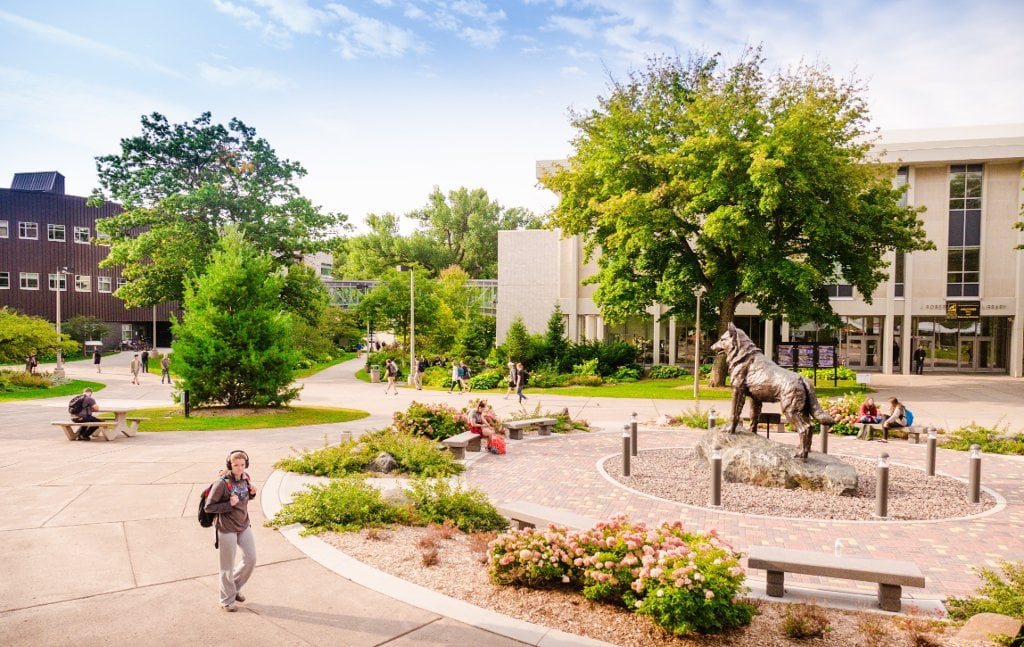

People who know Michigan Tech know that hands-on learning is a Husky hallmark. What they might not know is that one of the longest-running experiential-based programs on campus came to the University 29 years ago as part of a non-negotiable package deal.
The Applied Portfolio Management Program didn't yet have a name when Dean Johnson, then fresh out of grad school at the University of Wisconsin-Madison, applied for a faculty position at Tech. He hit the higher-education job market with a newly minted PhD and a determination to create a student investment program wherever he landed.
"I was telling people, 'Don't hire me unless you want one of these programs, because that's what I'm going to do,'" said Johnson, who became dean of the College of Business in 2016.
Johnson was aware of the potential consequences of his early-career decision. Faculty on the tenure track traditionally stay laser-focused on their own research until they're established. But he'd helped run UW-Madison's student investment program, one of the oldest in the country. He'd seen how effective such programs can be for nurturing smart, bold, financially savvy students ready for trailblazing careers in one of the most dynamic industries around.
Sticking to his vision paid off. Gene Klippel, then dean at the School of Business and Economics, hired Johnson and green-lighted the program.
"Let's let them be entrepreneurs."
It was far from the last risk Johnson would take to get APMP up and running. The benefits, for the College of Business and its students, have been well worth the effort. Both APMP and Johnson have earned state, regional, and national recognition. Students through the decades continue to make their mark in markets around the world.
But first, there were financial hurdles to clear.
This Is Not Play Money
Johnson wanted Huskies to work with real money. That's not how most undergraduate investment programs operate. The typical model is structured like a stock-picking club, operating in a simulated, low-risk environment. Johnson upped the stakes.
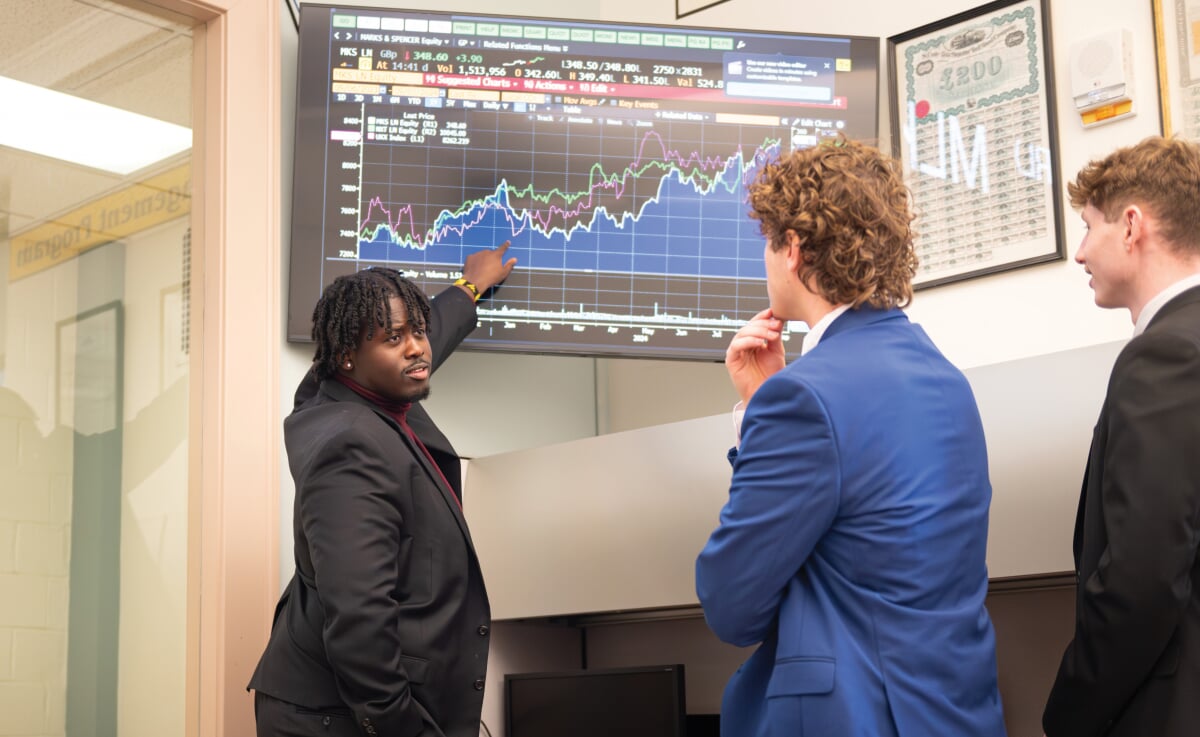
"The whole design of APMP is to maximize learning opportunities," said Johnson, who asked potential donors: "Do you trust the students? I do."
Initial supporters included Dewaine Olson '62 and Hugh Makens '61. Olson, now an emeritus member of the APMP Advisory Board, and Makens, now an emeritus member of the Dean's Advisory Council, saw the value in investing in students. APMP students were able to begin actively trading in 1998.
In 2003, APMP board member Joe Dancy '76 and wife Vicky expanded APMP's resources by leaps and bounds, sponsoring the LSGI Trading Lab, named for the investment advisory firm LSGI Advisors Inc., where Dancy is chairman and CEO.
APMP teams regularly meet there to go over the portfolio's performance, talk through market shifts, and present buy reports.
"In the trading room, deep in our weekly APMP team meetings—that's where the real magic happens," said 2024-25 APMP member Elijah Joseph.
"After someone presents their pitch, we don't just clap and move on, we vote," said Joseph. "And not just a simple yes or no. We require a supermajority to add anything to the portfolio. If the room isn't strongly behind the pick, we pump the brakes and ask more questions. Disagreement isn't a deal-breaker; it's a sign to dig deeper. That's the beauty of the process. It forces us to challenge ideas, sharpen our thinking, and make sure every move we make is backed by conviction, not just vibes."
Team members function as a firm, pitching their investment strategy to a client: the APMP Advisory Board, composed of industry experts. "Students retain full control of the investment decisions, subject to following their investment processes," said Johnson.
Praise for the Professor and Portfolio
Johnson, who received an endowment establishing him as the James and Dolores Trethewey APMP Professor and creating scholarships that support student participation in the program, has received numerous accolades for his teaching. A two-time Michigan Tech Distinguished Teaching Award winner, garnering the honor in 2000 and 2009, he was named Professor of the Year by the Presidents Council of the State Universities of Michigan in 2012.

"The awards are not so much about me as they are about APMP," said Johnson.
To his point, the program has racked up its own share of accolades over the years.
APMP Huskies have opened the Nasdaq Stock Exchange. Their success has been highlighted in Business Week magazine. For a time, Huskies were regular guests on the financial TV network CNBC.
APMP consistently ranks among the Top 50 undergraduate student investing programs in the nation. The portfolio, which began with $20,000, reached over $1.3 million by 2021. In 2025, it exceeded $3 million.
APMP grads have benefited beyond the one-year experience. While completing their degree work, many of them continue to learn as program alumni, working as APMP teaching assistants and mentoring new members. From Hong Kong to Houghton, graduates are taking lead roles in the financial sector.
Putting the Extra in Extracurricular
Students from any degree program at Tech can apply to be part of APMP. Grit matters more than grades. Johnson is looking for Huskies willing to commit to a deep dive into portfolio management. Applicants are selected at the end of each academic year and divided into two to three teams—Black, Gold, and Silver—to provide a competitive edge.
Johnson delivers summer lectures to help students develop their investment philosophy and strategy. In the fall at the advisory board meeting, Huskies pitch their plan and convince the board to hire them.
Joseph said the effort is worth it. "I applied to APMP because it felt like one of those rare, can't-miss opportunities. How often do you get the chance while still in school to manage a real multimillion dollar portfolio and make investment decisions that actually matter? I knew it would push me outside of my comfort zone and help me grow fast. And it absolutely did," he said, adding that APMP has been a crash course in both investing and professionalism. "I've grown more in this one year than I ever expected.
"Over the past year, I've learned how to evaluate stocks from both a fundamental and strategic lens, work under tight deadlines, and prepare for high-stakes meetings. I gained experience not just in presenting wins, but also in communicating tough updates and navigating uncertainty—skills that are just as important in the real world."
New York, New York
Other faculty are also integral to the program. Laura Sieders, assistant teaching professor and the Edward and Betty Robinson Faculty Fellow in Accounting, accompanied students on this year's trip to New York City. Huskies attend the largest student-run financial conference in the world, the Quinnipiac Global Asset Management Education Forum, featuring renowned industry experts and the highly anticipated Q Games, in which more than 130 university teams participate.
"There is nothing like experiential learning to really prepare students for the careers ahead of them," Sieders said, noting that Michigan Tech's APMP model is fairly unique among participating schools because Huskies are afforded a high amount of autonomy in managing funds.
In addition to the conference, APMP members had the opportunity to visit Teng Yue Partners. "During the visit to the firm's office just off Central Park, students are engaging with analysts, traders, and back-office personnel and learning directly from those currently in the jobs and careers to which our students aspire," said Sieders. "We are very grateful to an alum of the APMP program for making this connection, as well as Teng Yue Partners for opening their doors to us."
Joseph said visiting Teng Yue Partners was a highlight. "Talking to folks who actually make investment decisions for a living showed how much of this field is about curiosity, adaptability, and being comfortable with uncertainty. It was a solid reminder that while spreadsheets matter, so does the ability to think on your feet and not panic when things don't go according to plan which, let's be real, is most of the time in finance," he said.

Finance major and 2024-25 team member Marguerite Goldman '26 counts APMP among her most rewarding experiences at Tech.
"I conducted bottom-up equity research, built valuation models, and presented strategies and returns to the APMP board. I also served as my team's accountant, calculating portfolio returns and risk metrics. A highlight of the program was representing MTU at the Quinnipiac Global Asset Management Education Forum in New York City," she said. "I'm incredibly grateful to the APMP Advisory Board for making this experience possible and to Dean Johnson and Laura Sieders for their mentorship and support throughout the year."
Strengthening an Investment in Community
Like the College of Business itself, APMP never stops evolving. Johnson said the program is developing new ways for students to apply their knowledge by assisting nonprofit entities with portfolio reviews. One of their clients is the Keweenaw Land Trust, which conducts stewardship, conservation, education, and outreach in the western Upper Peninsula.
"We're working with the College of Business and specifically APMP students to do our investment reporting and tracking," said B. Lauer, KLT executive director. After conducting analyses of financial statements from the organization, Huskies will package the data and present their findings to the KLT finance committee and board.
The outreach is a natural progression of the professional and personal development that Johnson has witnessed in APMP Huskies through the decades.
"None of the students are doing this for the grade," he said. "They're part of this program because they have the drive and determination to set themselves up for success. I get to know them, push them, and watch them turn into great alumni."
APMP Alumnus Top-ranked in Forbes

Heath Johnson, who earned his bachelor's degree in finance in 2015 and master's degree in accounting in 2018, was named to Forbes' 2025 list of top next-gen wealth advisors in the Best-In-State category. A financial advisor with Insight Wealth Solutions, headquartered in Houghton, Johnson is an accredited portfolio management advisor (APMA) and chartered retirement planning counselor (CRPC).
Forbes interviewed every advisor under consideration for the designation. "Since we are recommending advisors to the public, we have to make sure every advisor is high quality and can provide impact," read the publication's methodology section.
"APMP had a lasting impact on both my financial literacy and my ability to convey that knowledge to help families achieve their goals," said Johnson, whose photo appeared on Nasdaq's MarketSite screen in Times Square as Huskies participated in the closing bell ceremony in 2017.
Michigan Technological University is an R1 public research university founded in 1885 in Houghton, and is home to nearly 7,500 students from more than 60 countries around the world. Consistently ranked among the best universities in the country for return on investment, Michigan's flagship technological university offers more than 185 undergraduate and graduate degree programs in science, technology, engineering, mathematics, computing, forestry, business, health professions, robotics, psychology, social sciences, humanities, and the arts. The rural campus is situated just miles from Lake Superior in Michigan's Upper Peninsula, offering year-round opportunities for outdoor adventure.