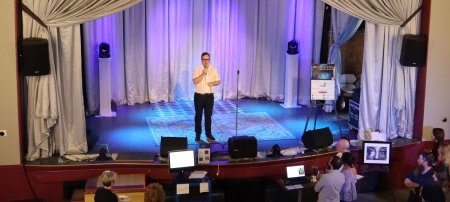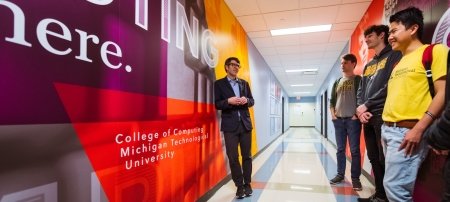


Michigan Tech student Jennifer Celeste is going places in the specialized field of acoustics engineering, including conferences, a summer internship with NASA, and graduate school thanks to a prestigious Barry Goldwater Scholarship.
Before coming to Michigan Technological University, Jennifer Celeste, a mechanical engineering junior, knew very little about acoustics engineering.
Fortunately, Celeste learned from a young age to keep her eyes and mind open to learning possibilities.
"My mom raised my siblings and me by herself, and she really valued education," said Celeste. "Growing up, I knew I wanted to make the most of the education I was given."
An early interest in math and science and a rigorous high school engineering program helped Celeste find her spark in mechanical engineering, though not in the same way as many of her peers.
"Most mechanical engineers love cars or airplanes, and that's a strong draw, but that never interested me much," she said. "I always thought it was cool in general, but I didn't have a specific application that I liked."
A valuable research experience in her first year at Michigan Tech helped her move from the broad field of mechanical engineering to acoustics. Also known as acoustical engineering, it's a branch of engineering that focuses on sound and vibration.
Being exposed to a field she'd known little about before coming to Tech, combined with her own determination and preparedness, led Celeste down a path she may have otherwise missed. In her first two years at Tech, she has worked directly with the University's renowned mechanical engineering faculty as a research assistant, developed her skills in programming and artificial intelligence, and attended and presented at national acoustic conferences. She also landed a recently completed internship at the NASA Langley Research Center.
Celeste, who received funding from the Michigan Space Grant Consortium and the Barry Goldwater Excellence in Education Foundation, returned from her summer at NASA with a clear vision of what's next in her career.
Finding Her Place in Husky Nation
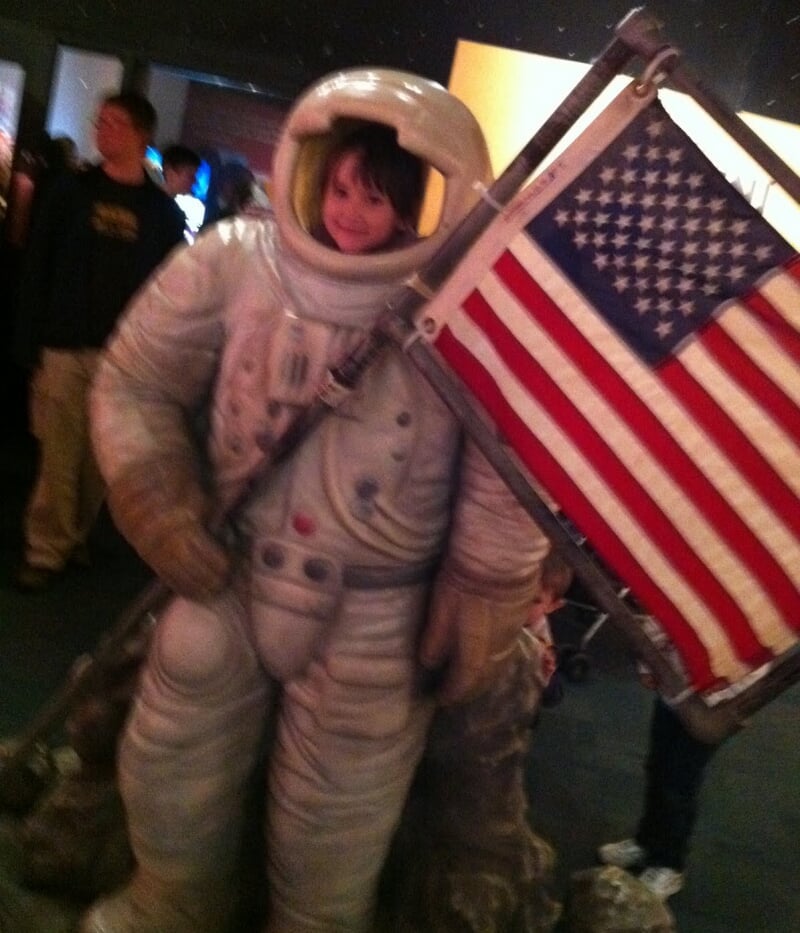
Celeste's dream to be an engineer blossomed at an early age as she was growing up in Downers Grove, Illinois. Her mom frequently took the family to museums in Chicago, especially the Museum of Science and Industry.
"That was my favorite place to be," said Celeste. "I loved all the science exhibits. From then on, I knew I wanted to do something in STEM."
In middle school, she received a gift box of games and puzzles from the Downers Grove South High School engineering program, specifically targeting young women who might be interested in their program. It got Celeste's attention. She participated in the program in high school, completing four years of various engineering courses.
"You got a taste of everything and by the end of that program, I knew I wanted to do mechanical engineering," she said. "It had the coolest projects, I thought. We had to make stuff that actually moved and I got to work on robotics projects."
Guided by her love for engineering, math and physics, Celeste knew what she was looking for when it came time to apply for college.
"I really wanted something different," she said. "I wanted a smaller school and something tech-focused."
That was how she found Michigan Tech — and when she visited campus, she was sold.
Not even the Upper Peninsula's most inclement weather could dissuade her. In fact, it may have convinced her further.
"It was mid-February when we visited, the dead of winter. It was freezing and everyone was so happy," said Celeste. "It was weird but I felt like this was the place for me."
"The campus tour was so focused on the community and all the opportunities available to students. We watched a broomball game. I had no idea what that was at the time but it seemed so fun! Hearing about all the traditions was exciting. It was what I expected college to look like, that sense of community."
Finding What Resonates
As a first-year mechanical engineering student at Tech, Celeste quickly looked for ways to get involved. She joined the swing dance club, lived in the Women in Engineering theme community, participated in programming workshops with the Women in Physics organization and kept up with playing badminton, one of her favorite pastimes.
During her first semester at Tech, she received an email inviting her to apply for the College of Engineering's then-newly launched Research Experience for Undergraduate Students (REU) program. The opportunity to assist with real research alongside faculty members — and to be paid for doing so — really interested Celeste.
"A lot of the research projects sounded fascinating and I needed a part-time job," she said. "That was my thought process then and I'm really glad I decided to apply. It's been wonderful so far."
Shortly after applying, Celeste met for an informal interview with Associate Professor Bhisham Sharma, director of research for the Department of Mechanical and Aerospace Engineering and director of the Mechanics, Acoustics, and Dynamics Lab (MADLab) which studies sound and vibration and designs engineered materials and structures to control them. Even though Celeste was a first-year student with little to no experience in acoustics engineering, Sharma was happy to take on a self-starter with programming experience to work on a new project applying artificial intelligence (AI) to the lab's acoustics research. Celeste's badminton game clinched the deal; many members of Sharma's lab play badminton together to bond and unwind.
"That was a good connection," said Celeste. "A few days later, he asked if I wanted to join the lab, and I said yes. I've been working there ever since January 2025, my second semester at Tech."
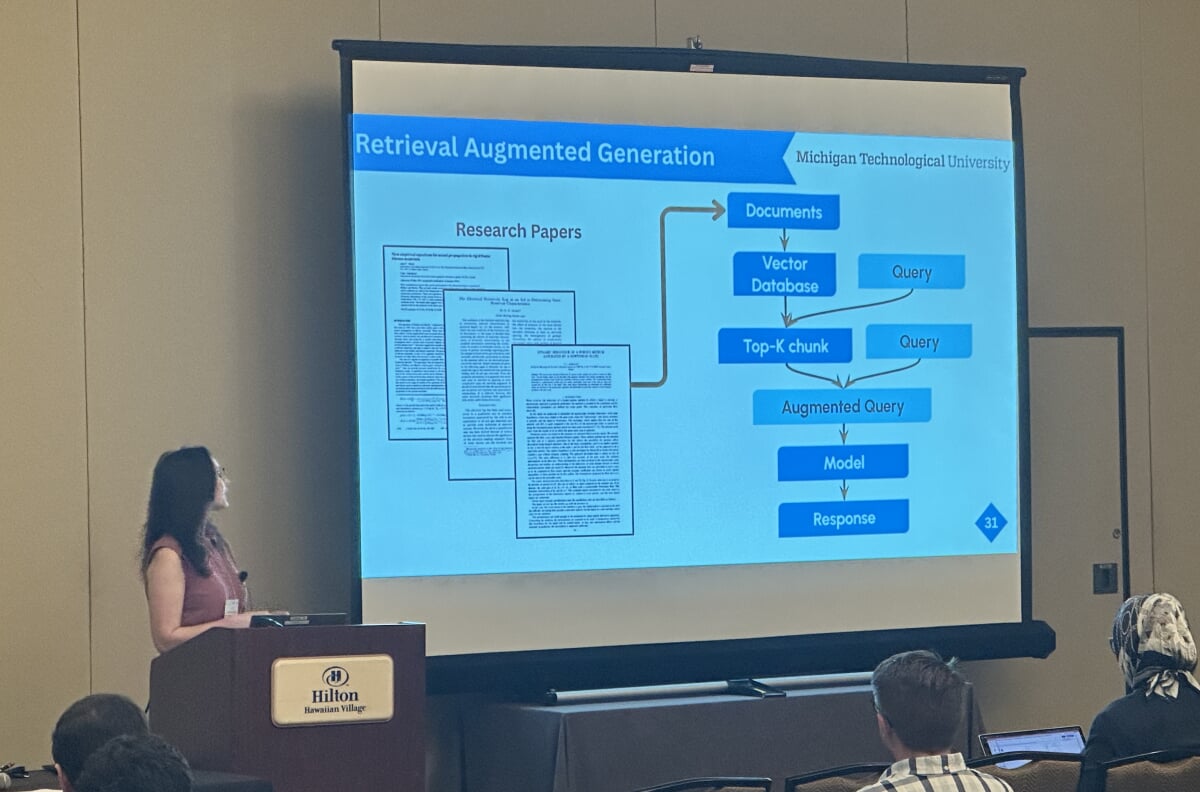
Celeste marks her decision to join Sharma's lab as a turning point. That first semester and the following summer working in the lab, Celeste spent her time learning all she could about acoustics, programming and AI, including how large language models (LLMs) work and how to build AI tools, such as retrieval-augmented systems, to support research.
That same summer, Celeste traveled to Vermont to attend her first NOISE-CON, the premier conference for professionals and students working in the field of noise control and acoustics, hosted by the Institute of Noise Control Engineering. At the conference, Celeste experienced more of the ever-expanding field of acoustics engineering.
"I got to meet Ph.D. students and talk to them about their work, which was really exciting," she said. "I knew research was a career option, but I was kind of on the fence about it. I was always planning on going into industry. It was great to hear their perspectives."
She was also able to hear her fellow lab members present their own work and was blown away by the specificity of their research and knowledge.
"It's not just a general understanding of mechanical engineering; it's a specific field, with their niche applications," said Celeste. "The idea that they were only a few years older than me, but that they knew so much, I knew I wanted to be like them."
By the time she was entering her second year at Tech, Celeste had acquired a breadth of research and professional experiences that were helping to shape her career goals. Research, particularly in AI applications for mechanical engineering, was sounding more and more like the right path for her.
Shooting for the Stars
During that first summer in Sharma's MADLab, Celeste began sitting in on joint meetings between the lab and NASA, led by one of the lab's Ph.D. students who had been working with the national organization. Celeste began working closely with that Ph.D. student and her NASA advisor. When the NASA advisor was looking to start a cohort of early career professionals with training in AI at the NASA Langley Research Center, Celeste again was primed for the opportunity.
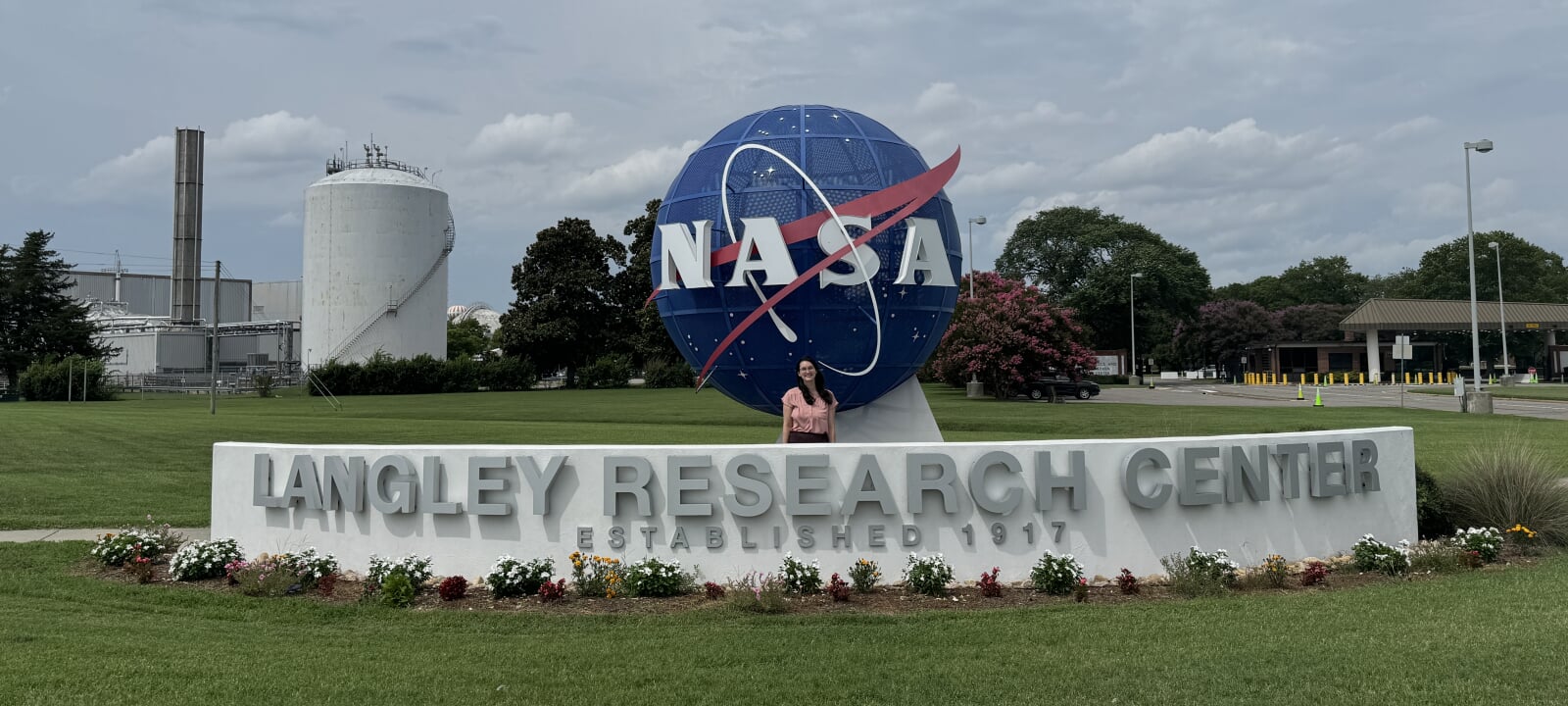
"Their goal is to connect early career professionals with NASA civil servants to use the intern's knowledge on AI to inform the work being done at NASA," explained Celeste. "There are a lot of people who really have their doubts about AI, or want to use it but don't know where to start or where it could be useful in their work. The idea was to be able to bridge that gap."
During summer 2026, Celeste was an AI research associate at the NASA Langley Research Center, thanks in a large part to the Michigan Space Grant Consortium (MSGC). Created in conjunction with the National Space Grant College and Fellowship Program, the MSGC provides funding for students, researchers and programming in Michigan that aligns with NASA's strategic interests.
Celeste was funded by MSGC's undergraduate research grant for her work in Sharma's lab and received additional funding to complete her work at NASA. "All the funding to get me to NASA came from the Michigan Space Grant," she said.
In March 2026, Celeste's endeavors took another leap forward. She was awarded the prestigious Barry Goldwater Scholarship, a national scholarship program established by the U.S. Congress to honor the lifetime work of the late U.S. Sen. Barry Goldwater of Arizona.
The scholarship provides $7,500 per year to rising college juniors and seniors who intend to pursue research careers in the natural sciences, mathematics and engineering. Celeste is one of only 13 Michigan Tech students to have ever received this honor out of the more than 11,600 scholarships awarded since the program's inception in 1989.
Applying for the scholarship was no small feat. The lengthy application process included writing a research narrative, submitting multiple letters of recommendation and including a resume with ample research and educational experiences. Celeste had heard about the opportunity when she was still a high school student and was unsure if it would be the right fit. When it came time to apply as a second-year college student, the experiences she'd gained during her time at Tech made her a perfect candidate. She also got a lot of encouragement.
When Celeste asked Sharma's opinion on applying for the scholarship, he told her to go for it. He recognized her determination from the beginning and has watched it grow since the pair met.
"Jennifer showed up ready to play — on the court and in the lab," said Sharma. "She doesn't wait to be told what to learn; she chases it down herself. That's the same drive that carried her from a first-year REU applicant to a Goldwater Scholar and NASA research associate in under two years."
With her research experience, a NASA internship and the prestigious Goldwater Scholarship already in hand, Celeste is headed to graduate school. Her honors at Tech also include the Department of Mechanical and Aerospace Engineering's John Johnson Scholarship, awarded to students of exceptional promise who intend to pursue a career in academia.
"I plan to graduate a semester early and then to start a Ph.D. at Michigan Tech if possible," said Celeste. "My overall career plan is to become a professor."
"I want to teach, conduct research, make my own lab and foster the same opportunities for other students that were made available to me."
"The biggest surprise to me is how much there is to learn in mechanical engineering," she said. "I have taken a lot of courses already, but there's still so much to learn. Now, with my undergraduate research, I'm focused on acoustics and I didn't even know that was something I could do two years ago. Acoustic engineering is such a niche, interdisciplinary field and I'm excited to keep learning more about it."
Thanks to keeping her eyes on the future, thinking forward, and aiming high even as her goals changed, this Husky's bright future is that much closer.
Michigan Technological University is an R1 public research university founded in 1885 in Houghton, and is home to nearly 7,500 students from more than 60 countries around the world. Consistently ranked among the best universities in the country for return on investment, Michigan's flagship technological university offers more than 185 undergraduate and graduate degree programs in science, technology, engineering, mathematics, computing, forestry, business, health professions, robotics, psychology, social sciences, humanities, and the arts. The rural campus is situated just miles from Lake Superior in Michigan's Upper Peninsula, offering year-round opportunities for outdoor adventure.