In the Department of Mechanical and Aerospace Engineering, students at every level have the opportunities to pursue their goals and make their mark on campus.
Cora Taylor: Shifting Gears from Michigan Tech to the European Research Circuit
By Becky Barnard
Cora Taylor, BS '18, MS '20, PhD '24, enrolled as a first-year at Michigan Tech with a finish line in mind: a bachelor's in mechanical engineering, leading to a career in engineering for an IndyCar or NASCAR race team. Now, after a high-speed academic career full of twists and turns, a new course as a postdoctoral researcher in Leuven, Belgium, lies ahead.
From Cardboard Prototypes to Brake Line Redesigns
Michigan Tech was a natural fit for Taylor, who grew up in Charlevoix, Michigan. Her father, a forestry alumnus, introduced her to the Copper Country during family vacations. But it wasn't until she joined her high school's FIRST Robotics team that engineering truly clicked. Bill "Shap" Shapton, a fellow Charlevoix native and professor emeritus of mechanical engineering at Michigan Tech, was one of the team mentors.
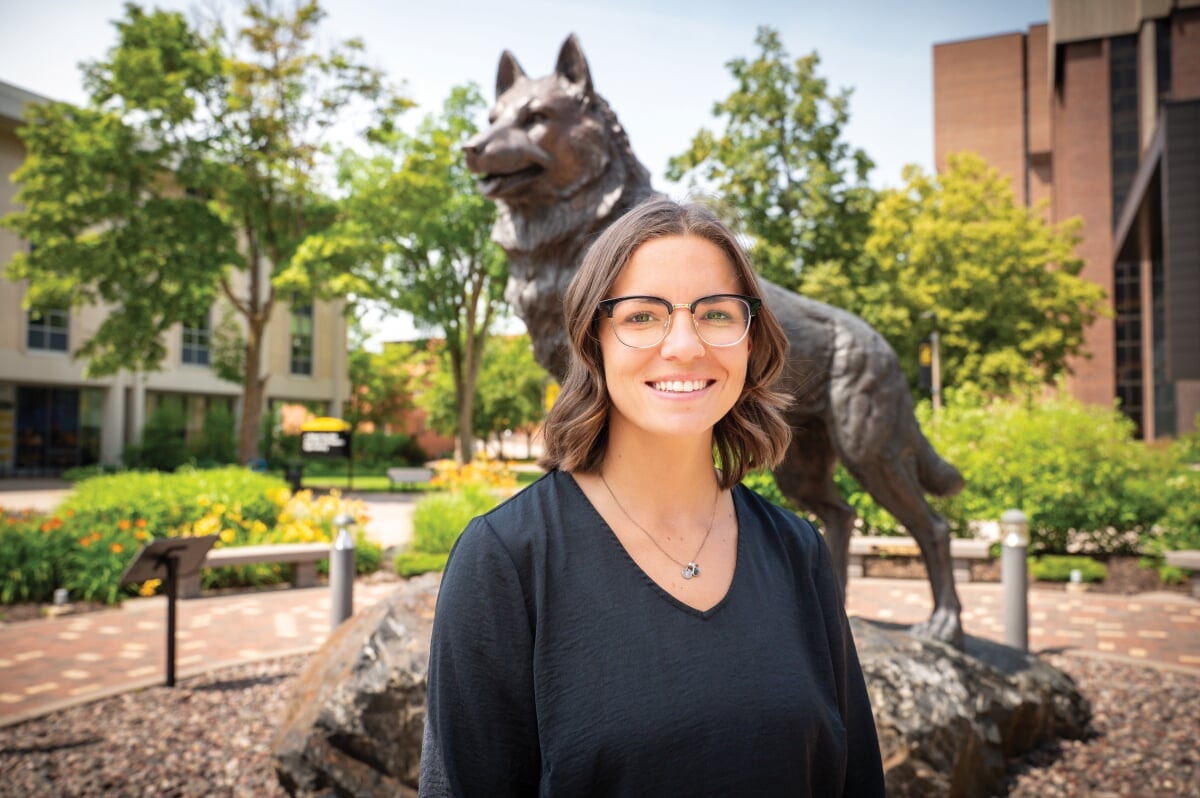
"Shap taught me about projectile motion before I had ever taken a physics class. He showed me the power of developing prototypes out of pieces of cardboard. I learned a lot from him, and, of course, being a Tech professor, he kept nudging me towards Houghton," said Taylor.
At Tech, Taylor was constantly in motion, working on her undergraduate degree, joining Delta Phi Epsilon, skiing at Mont Ripley, serving as an Orientation Team Leader, and winning the Winter Carnival Royalty competition. But it was Formula SAE, part of the Advanced Motorsports Enterprise, that became her second home. Taylor worked on everything from composites to chassis to CAD to business presentations, and ultimately served as team president. Under her leadership, the team achieved one of its highest competition rankings in two decades, finishing 36th out of 125 teams.
"Formula took up most of my time, and I loved it," said Taylor. "That final year, we placed in the top 10 for our business presentation and did really well across the board. I even drove the car at the competition."
Outside the classroom, Taylor's undergraduate career included internships with Toyota and Michigan Scientific Corporation. At Toyota, she performed special studies, including finite element analysis and co-rotation studies on a redesigned brake line. She found an incompatibility between the new brake line and the planned exhaust system. "It was a cool thing for an intern to find," Taylor said. "And I got to follow up on it—I showed my findings to the exhaust team and showed that somebody had to move. We weren't sure if it was the brake team or the exhaust team, but someone had to move their stuff."
Teaching, Leadership, and Staying On Track
As Taylor took upper-level courses in dynamics and vibrations, her career trajectory started to change from auto racing to academics. Encouraged by faculty mentors like Jim DeClerck and Jason Blough, and drawn to hands-on experimental work, she chose to stay for a master's degree, and then a PhD.
"I've always enjoyed teaching and leadership, and thought that teaching could be a good alternate career path if engineering wasn't the right fit," said Taylor. She initially considered an undergraduate dual major in engineering and math education. When she found out that a master's degree is a valid teaching credential in many places, going that route made sense.
"Early in my master's, I was sitting next to Jim DeClerck on the plane back from the IMAC conference and we were talking about my career plan," Taylor said. "He grabbed some paper and basically mapped out my entire master's, and at the bottom of the page there was a little section that said, 'PhD?'"
Her PhD focused on impedance mismatches in vibration testing. When engineers test components like electronics or camera mounts, rigid lab fixtures can fail to replicate the dynamic conditions of real-world use, such as those experienced on a drone or in a missile in flight. Taylor designed test setups that mimic actual field dynamics, enabling more accurate testing and ultimately more reliable products.
Beyond the Checkered Flag: Dynamics Research at KU Leuven
After establishing deep academic roots at Michigan Tech, Taylor took the advice of her mentors seriously: get experience elsewhere. In fall 2026, she's heading to KU Leuven (Katholieke Universiteit Leuven) in Belgium, where she'll work on a postdoctorate characterizing and mitigating vibrations in electric vehicles, specifically looking at tire, bushing, and gearbox dynamics.
"If you stay curious, opportunities will come."
"It's kind of a return to automotive, but with a new perspective," she said. "Electric vehicles don't have engines to mask vibrations, so we have to understand all the other noise and vibration sources in more detail."
Her postdoc will also feed another lifelong interest: travel. With plans to ski in the Alps and visit the UK, Ireland, and beyond, Taylor is excited to explore Europe while continuing meaningful research.
Advice for Huskies at the Starting Line
Asked about her favorite memories from Tech, Taylor didn't hesitate. "Winter Carnival. I loved building statues with my sorority. And I'll never forget camping under the stars on Lake Superior, watching a lightning storm roll in."
Taylor's advice to new Huskies is to stay open to new experiences. "I thought I knew what I wanted starting out, but I changed my mind—big time," she said, laughing. "If you stay curious, opportunities will come."
Jacob Bruesch Envisions Success for MTU Mechanical Engineers
By Coby-Dillon English
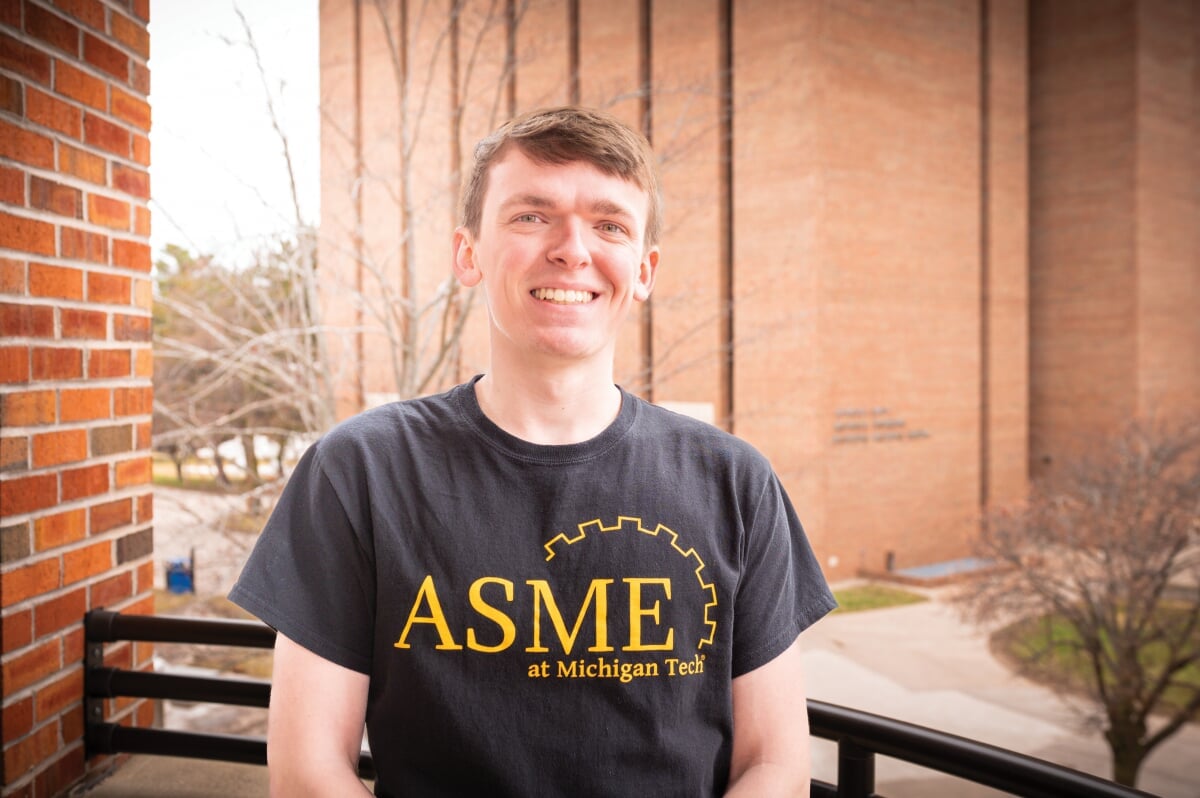
Soon after becoming the president of Michigan Tech’s American Society of Mechanical Engineers in 2024, Jacob Bruesch began a necessary revival of the organization in order to properly meet the needs of his fellow engineering students.
"I was thinking, 'How can I make the biggest impact in a club like this?'" said Bruesch. "I knew the experiences and opportunities that I wanted, but I didn't have an individual channel to make that happen. So, I wanted to help the club so that all mechanical engineers had this opportunity."
Since Bruesch and his fellow executive board members reinvigorated ASME, the organization has hosted internship and career panels, social functions with other professional engineering societies on campus, and coordinated a field trip to Fincantieri Marinette Marine and Enstrom Helicopter Corporation. ASME members were able to see how helicopters and large shipping vessels were built, from the ground up.
Read the full story about Jacob Bruesch and ASME.
Departmental Scholars
The MAE Departmental Scholar Award is given to a rising senior within the department who best represents student scholarship at Michigan Tech. This outstanding student is recognized not only for their academic performance, but also for participation in research scholarship activity, intellectual curiosity, creativity, and communication skills. In addition, the MAE department offers scholars and finalists a one-year fellowship to continue their studies at Michigan Tech as graduate students.

Katherine Rauscher
MAE Departmental Scholar
Nominated by William J. Endres, Richard and Elizabeth Henes Professor of Mechanical Engineering
Originally from Wausau, Wisconsin, Katherine Rauscher is majoring in mechanical engineering with an Enterprise concentration and a minor in aerospace engineering. Rauscher is the Lunabotics project manager of the Multiplanetary INnovation Enterprise (MINE) and the chair of the MAE Student Advisory Committee. She plays French horn in the Keweenaw Symphony Orchestra and has served as a resident assistant in the Pavlis Honors College. After graduation, Rauscher plans to pursue an MS in Mechanical Engineering at Tech, focusing on aerodynamics and computational fluid dynamics.

Justin Carrier
MAE Departmental Scholar Finalist
Nominated by Gordon G. Parker, John and Cathi Drake Endowed Chair in Mechanical Engineering
Justin Carrier is a mechanical engineering major from Grand Blanc, Michigan. Carrier is a student member of MTU Wave, a collaborative wave tank laboratory and research group. He has been included on the Dean's List for five semesters during his time at Michigan Tech. After graduation, Carrier plans to continue his studies at Tech as a master's student in the MS in Mechanical Engineering program under the mentorship of Professor Gordon G. Parker.
Michigan Technological University is an R1 public research university founded in 1885 in Houghton, and is home to nearly 7,500 students from more than 60 countries around the world. Consistently ranked among the best universities in the country for return on investment, Michigan's flagship technological university offers more than 185 undergraduate and graduate degree programs in science and technology, engineering, computing, forestry, business, health professions, humanities, mathematics, social sciences, and the arts. The rural campus is situated just miles from Lake Superior in Michigan's Upper Peninsula, offering year-round opportunities for outdoor adventure.