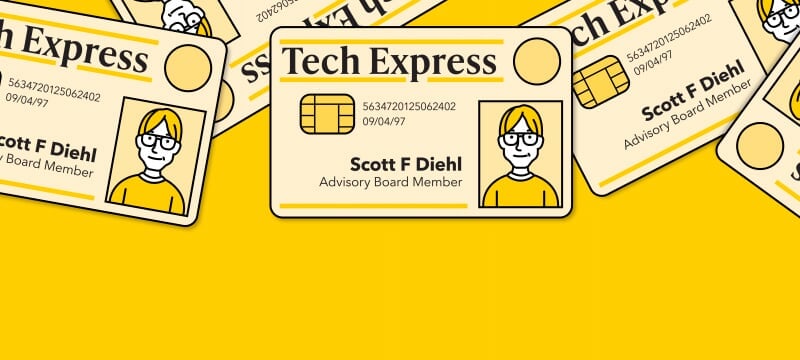
Scott Diehl is a Houghton guy through and through, with strong family ties to Michigan Tech. One of the College of Computing’s 10 external advisory board (EAB) members, Diehl is a senior software engineering manager at Google who has worked for the company since 2010.
Diehl, a 1999 Houghton High School graduate, took classes at Michigan Tech in his junior and senior years before going on to earn his bachelor’s and master’s degrees in computer science at the University of Michigan. He received his PhD in Computer Science at the University of Wisconsin-Madison. Before joining Google, he was an assistant professor of computer science at Siena College.
In this Gateway Magazine Q&A, Diehl shares personal insights, memories, and why he’s excited to serve on the College of Computing’s EAB. To be clear, the views expressed are his own and don’t reflect the positions or policies of his employer.
Q: You took classes at Tech while you were still attending Houghton High School—what did that opportunity mean to you?
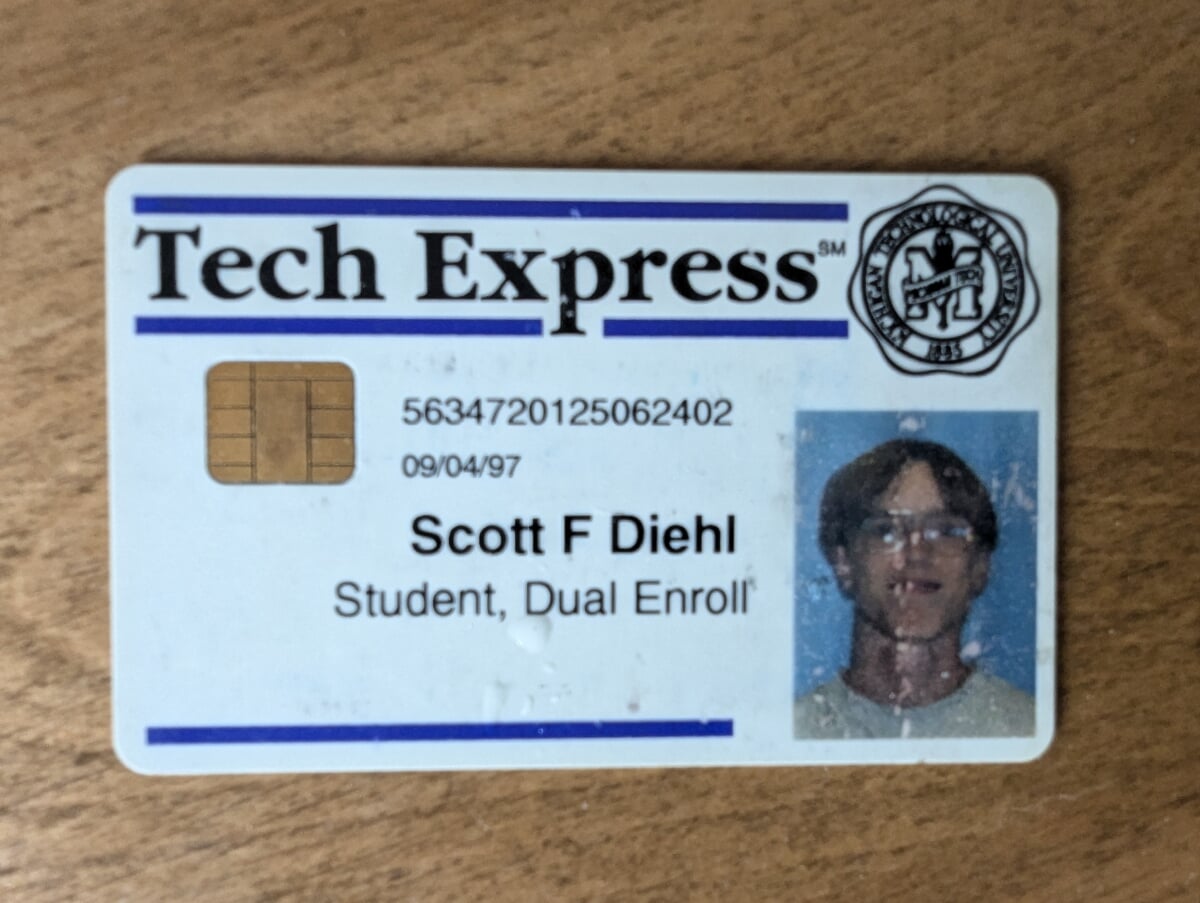
SD: Initially, it was purely a matter of scheduling. In my junior year, Spanish 3 conflicted with Computer Programming 2, and enrolling at Tech let me take Spanish at Tech and Computer Programming 2 at Houghton High School. I continued on with more Spanish and then (back when Tech was on a quarter system) psychology. My senior year I took both calculus and intro computer science (CS) courses up through data structures.
In hindsight it’s evidence of what a privilege it was to attend a public school—a rural one, no less—that offered not one but two years of computer programming, that prepared me well for college-level calculus, that had a breadth and depth of language classes—and on top of that, that I could enroll at Tech to continue learning without missing a beat.
Q: Your mom and dad, Jimmy and Suzanne Diehl, were longtime faculty members—the first husband and wife to share a full-time academic position at Tech. They taught geophysics and conducted widely acclaimed research. Did you ever think about going into that field or did they encourage you to strike out on your own?
SD: I think it was pretty clear from an early age where my interests were, given the time I spent on our Commodore 64 playing games and programming, and my parents seem to have enjoyed seeing what I could create. They pushed their “big rocks agenda” in a joking-only way, like when we were on road trips and they’d exaggeratedly exclaim, “Ooh, kids, look at that basalt outcropping!” to many eye-rolls.
Later, I did take geophysics to satisfy my science elective credit requirement at Michigan, though, so I did get a little taste of what the basics of their field were like.
Q: You’ve been at Google since 2010, beginning as a software engineer. What drew you to the company and why have you stayed?
SD: I was teaching at Siena College in Albany, New York, at the time and, as much as I hate to admit it, it was really hard for me to be that far away from home. A few colleagues from graduate school had joined a newly formed Google office in Madison, Wisconsin, and when I heard they were hiring it sounded like a great opportunity to (a) move back, but (b) continue to check the other items on my job “must-haves.” Google felt like they were solving big, hairy, important problems, would be a place I could keep learning new things, had a great culture, and would afford a healthy work-life balance. That’s all panned out! I’ve stayed because I haven’t found another place that can match those features. There’s also a lot of pride I have in continuing to see the things I’ve helped build evolve and the careers I’ve had a hand in shaping play out over time.
Q: This Gateway Magazine issue is examining the many aspects of artificial intelligence, so we would love to hear any perspectives, predictions, or preparedness tips for students related to how AI is affecting your field.
SD: When I read Fred Brooks’ The Mythical Man-Month in college, there was a passage about why we become programmers that resonated with me so deeply that I wrote it down (in my LiveJournal at the time—the rest of the content doesn’t hold up so well as this quote, unfortunately): “The programmer, like the poet, works only slightly removed from pure thought-stuff. He builds his castles in the air, from air, creating by exertion of the imagination.”

The progress of technology over the decades has been to shrink that “remove” between thought and creation: punch cards to teletypes to VI/EMACs editors to graphical IDEs; and binary instructions to assembly language to compiled languages to OO programming languages to interpreted languages. AI programming tools are a continuation of that progress, and perhaps even could eventually fully realize that promise, that by uttering your thoughts aloud, the AI will understand and usher them into reality.
From that perspective, I see the rapid evolution of AI tools creating a richer, more vibrant, and more satisfying field of study and practice in computer science.
While that's how it looks for computer science, the cost/benefit seems less clear in other domains at the moment, as well as numerous considerations related to the costs of data center build-out and other important challenges. But I generally see Google having thoughtful conversations rather than careening forward, and I like being a part of that.
Q: Can you give us some more specifics?
SD: In many fields, computer science in particular, what’s challenging or hard is changing fast. The way we’d go about getting a software project done six months ago is different than we’d do it today, and will likely be different six months from now. The analogy I think of is that few people code in pure assembly anymore thanks to rich compiled (C++) or interpreted languages (Python).
If you were to deliver (most) software projects today by writing them completely in assembly, that would be crazy. But in the era, say, when compiled languages were still on the rise and compilers were still rough around the edges in the quality of code they’d produce, you could make the case that it made sense to hand-code parts of the system in assembly, e.g., a performance critical section where there was a high return on investment for fine-tuning the assembly rather than leaving it to the compiler. But those places where there was a positive return on investment shrank over time, to the point where it’s a vanishingly small portion of the trade. We’re in a similar situation now with AI coding tools: They are still rough around the edges and there are places where it’s best to step in and fine-tune yourself. So today, where you’ll differentiate yourself is developing and applying good judgement on where to step in yourself—and then evolving that judgement as AI evolves and improves, and eventually—probably—stepping off the critical path in almost all cases.
That said, I’m young enough that I wasn’t really around in the industry when compiled languages overtook assembly programming, so maybe I’m hallucinating this analogy!
Regardless, it’s clear that advances in programming languages haven’t replaced the value of understanding the fundamentals underpinning what you’re doing, e.g., writing performant code still requires understanding caching, time/space tradeoffs, data structure choices, parallelism, etc. I suspect the same will continue to be true in the AI era.
Q: Any advice for students wanting to break into a major company like Google? The company has attended Michigan Tech Career Fairs, but are there other ways to do outreach?
SD: In hindsight, the non-degree activity that helped me the most to prepare was competing in programming contests. I was on the UW-Madison ACM ICPC (International Collegiate Programming Contest) team one year and coached teams for six more years. It helped me develop the skill of quickly finding the right algorithm, data structures, and high-level code organizations to stitch them together that played right into the Google interview process at the time. It’s also a good way to get noticed.
Q: Tell me about the teaching you’ve done. What did you enjoy about it?
SD: I taught computer science at Siena College for two years, and across UW and Siena I coached ACM ICPC programming teams for four. I taught computer organization, theory of computing, data structures, cryptography, and some service classes. I liked finding ways to connect the material to the students and guide them through the learning process.
Q: It looks like you’re working with really cool technology and solving challenging problems. Can you give us an example of things you might do in an average day, or is no day average?
SD: The thing that amazes me when I step back to think about it is the scale of Google’s infrastructure that we use day-to-day to get our job done—and mostly take for granted. When I edit a few lines of code, run a simple test, validate it on real hardware, and submit it to the codebase, there’s massively complex things going on in the background that enable it to compile millions of lines of code in seconds, run thousands of tests in minutes, generate petabits of network traffic without breaking a sweat, test its interactions with dozens of other systems implicitly and explicitly, store it all for easy access and debugging from anywhere, etc., etc. It’s wild.
I’m also a manager, which lends my job a much more prosaic day-to-day experience: mapping out peoples’ careers, finding what the best opportunities are to help them grow, coaching them through challenges, how to set a strategy and position the team to enable us to accomplish big things, etc. I find that as rewarding—or more—as the technical challenges.
Q: Why did you agree to serve on the external advisory board? What do you look forward to as the group solidifies goals and helps the College meet what feels like a truly revolutionary era in computing?
SD: It was an honor to be given the opportunity to help shape the success of the University that played such a large role in my life. My parents taught at Tech. I attended Tech daycare and am still friends more than 40 years later with kids I met there. I used Tech’s internet access to reach out to the world in middle school, I attended classes during high school. I got married at the Rozsa Center for the Performing Arts. My parents built a really neat PMAG (paleomagnetism) lab there and my mom played an integral part in founding the childcare center. It was really a privilege to grow up with the advantages afforded to me by my family and community’s association with Tech, and I’m excited to be able to give back in some way.
I’m looking forward to providing a perspective from industry as to how the skills we are looking for in students are—and are not—changing.
Q: How often do you get back to visit Houghton?
SD: My parents moved away last year so I’m still figuring that out. We are probably aiming for once a year during the winter to enjoy the Tech Trails, but we may also be up in the fall for the EAB meeting.
Q: Anything we missed or anything else you’d like to add about Tech in general?
SD: Yes, I want to start a campaign for Tech to bring back the Husky logo from the ’80s. The stacked “M-T-U” from that era is also pretty great.
Michigan Technological University is an R1 public research university founded in 1885 in Houghton, and is home to nearly 7,500 students from more than 60 countries around the world. Consistently ranked among the best universities in the country for return on investment, Michigan's flagship technological university offers more than 185 undergraduate and graduate degree programs in science, technology, engineering, mathematics, computing, forestry, business, health professions, robotics, psychology, social sciences, humanities, and the arts. The rural campus is situated just miles from Lake Superior in Michigan's Upper Peninsula, offering year-round opportunities for outdoor adventure.