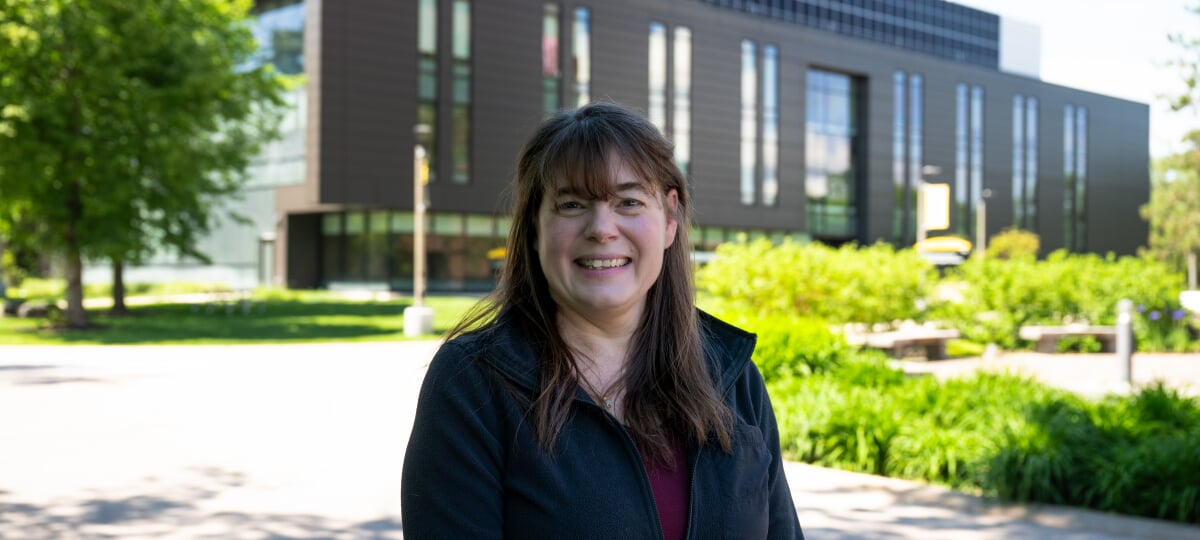
For her leadership and development of a contact tracing program during the COVID-19 pandemic, Kelly Kamm has been selected to receive Michigan Technological University's 2026 Faculty Distinguished Service Award.
During the COVID-19 pandemic, public health departments and healthcare systems were overburdened as they navigated the pandemic’s shifting circumstances and protected community health. Kelly Kamm, Michigan Tech’s Copper Shores Community Health Foundation Endowed Assistant Teaching Professor, saw this as an unprecedented opportunity to aid in community response.
“I'm trained in public health, specifically in infectious diseases, and although we hope it doesn't happen, this is what we are trained for,” said Kamm, who teaches in Tech’s Departments of Kinesiology and Integrative Physiology and Social Sciences. “I was positioned to support our local health department, which was clearly going to be overwhelmed very quickly, as all health departments were, so I had an obligation to do what I could.”
Kamm’s background is in infectious disease epidemiology, specializing in rural and other resource-limited communities. She stepped forward with her expertise to establish, coordinate and conduct a contact tracing program for Michigan Tech’s campus community, with approval from the Western Upper Peninsula Health Department (WUPHD).
Contact tracing is a labor-intensive process that involves rapidly identifying, assessing and managing people who have been exposed to a disease to limit its transmission to others. People infected with COVID-19 can spread the disease to others for several days before they have symptoms or know they are sick. Contact tracing allows public health organizations to quickly identify people who were exposed to the disease and quarantine them before they reach the infectious stage. Quarantine doesn’t stop the quarantined person from becoming infected, but it is meant to stop the spread beyond that person.
“In a campus setting where students interact with a large number of people each day, limiting the number of individuals exposed to someone with COVID was key to preventing explosive outbreaks,” said Kamm. “Here in our region, because we have limited access to medical care, it was really important to try to prevent large outbreaks that might overwhelm our healthcare systems and support structures we had on campus for students who were ill.”
Filling in the Gaps
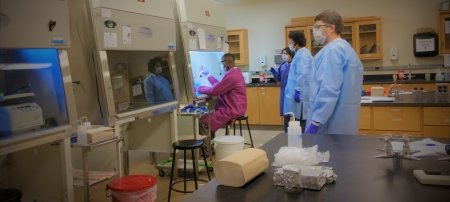
WUPHD faced the pandemic with limited staff and had to focus its efforts on vulnerable populations, such as the elderly and school-age children. Kamm’s confidential contact tracing program filled in the gaps, supporting over 1,700 quarantined students and their contacts on Michigan Tech’s campus alone. To accomplish this, Kamm recruited, trained and supervised a cohort of students who worked to identify the contacts of infected individuals. The cohort ensured that quarantined students had accurate public health information and other resources, and checked in on them daily.
Matthew Weekley, executive director of Tech’s Residential Living department, worked closely with Kamm throughout the pandemic.
“Oftentimes it is said that the real character of leadership is born during adversity and crisis,” said Weekley. “When the COVID-19 crisis paralyzed the world, Dr. Kamm rose to the task, involving herself in a campus auxiliary operation to put theory to action and preserve the health and well-being of our students.”
Contact tracing for Michigan Tech’s student population presented unique challenges in organizing data and keeping it confidential. Since the University is not a public health department, it could not access the state system for outbreak investigations. Kamm helped facilitate confidential data collection by obtaining contact tracing software from the World Health Organization, using a firewall to keep the data separate from the University’s systems and only available to her tracing team. She developed a training platform for student “tracers” and personally managed complex quarantine cases in larger living groups and athletic teams.
Faculty Distinguished Service Award
The Michigan Tech Faculty Distinguished Service Award recognizes faculty whose service to the University community has significantly improved the quality of some aspect of campus or community life. The award is intended to recognize exceptional rather than integrated service. The work could have resulted, in part, from compensated efforts, but it must have been of a level that distinguishes itself above and beyond the normal execution of those tasks. Nominations are solicited from University members and reviewed by the award committee. Winners receive $2,500 and a plaque at an awards dinner sponsored by the Office of the President in the fall.
“My contact tracers were an amazing group of students who dedicated an immense amount of time to helping keep our campus and community safe,” said Kamm. “We were really building the plane as it was already flying. For the students on my team, it was a chance to see firsthand all the other factors — like food access, exercise, mental state, and access to care — that impact a person's health.”
The tracing team handled over 1,500 close contacts during the 2020-21 academic year. Every person who self-identified as a close contact or was reported as a close contact received an initial phone call to confirm whether they were a close contact or not and explain the quarantine process. Then, for the next 10-14 days — depending on the guidance at the time — each person in quarantine received a daily call. The contact tracers asked about symptoms and attempted to determine if the individual needed any additional support. They answered questions, connected people to resources and helped address any issues that arose.
As a result of Kamm’s efforts, alongside others, Michigan Tech was one of just a few universities in the U.S. with a robust return-to-campus and COVID-19 testing plan in fall 2020. Jennifer Becker, an associate professor of civil, environmental, and geospatial engineering and the 2024 recipient of the Faculty Distinguished Service Award, saw the positive ripples of Kamm’s work long after the pandemic ended in her conversations with graduating seniors.
“Frequently, the parents of students who started their studies at Michigan Tech during the 2020-2021 academic year mentioned that Michigan Tech's COVID response measures, including the contact tracing program, made them feel confident that Michigan Tech was sincerely looking after the well-being of their children,” said Becker.
Public Health Education for the Campus Community and Beyond
Kamm also volunteered alongside Steve Elmer, then an associate professor of kinesiology and integrative physiology at Tech, to hold a community town hall series to educate the campus and wider community about the pandemic. The weekly series, which was supported by Michigan Tech’s Health Research Institute, began in September 2020. Following the fall 2020 semester, it continued monthly into 2024, broadcast on Zoom, Facebook Live and several local radio and television stations.
Town hall themes included the role of public health to protect community health; interrupting and halting virus transmission; the impact of disease on physical and mental health; health disparities; and strategies for adapting to lifestyle changes. Kamm ensured the long-term sustainability of the town hall series as it transitioned to the Northern Michigan University Center for Rural Health, where it subsequently focused on broader community health issues.
With the help of Department of Kinesiology and Integrated Physiology graduate students, Kamm also managed the department’s COVID-19 online resource hub, which included biweekly newsletters with up-to-date COVID-19 information and resources for free test kits and masks.
“Kelly’s efforts to increase public health messaging during the pandemic were a critical step to keeping Michigan’s rural Upper Peninsula informed, safe, and healthy,” said Elmer.
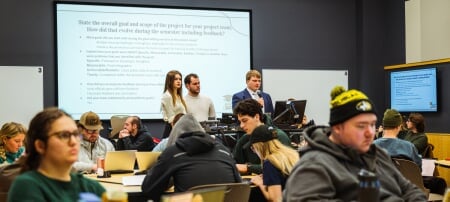
In addition to teaching her regularly assigned classes, Kamm took advantage of the pandemic as a real-world teaching opportunity, developing and teaching a course called COVID-19 Impact and Response alongside Elmer.
“The course was in response to the misinformation that was rampant in the world at the time,” said Kamm. “We also wanted to allow students to think broadly about how COVID was impacting different parts of our world, not just health.”
Students heard from professionals in areas impacted by COVID. Topics ranged from healthcare discussions with an emergency room doctor to talks with business owners about how they’d been impacted by stay-at-home orders. Each seminar also included an update on the status of the pandemic, locally and regionally, to help students interpret what the numbers meant for campus and the larger community they were living in.
The instructors also highlighted common myths and misperceptions to provide students with evidence they could use to protect their own health and help combat misinformation within their networks.
“Students' questions for the guests showed that the students were open to understanding different viewpoints and wanted to have accurate information,” said Kamm. “One student told us he had a weekly meeting with his roommates to share the information he'd learned in class that week.”
In 2022, Kamm and Elmer published a brief on their pandemic efforts titled “Leading at the Edge During COVID-19: Challenges, Opportunities, and Future Pandemic Preparedness” in the journal Kinesiology Review, ensuring that what they learned through the experience can benefit public health officials in the future.
Kamm’s above-and-beyond attitude earned the support and admiration of Dave Reed, Tech’s former vice president for research.
“Dr. Kamm was dealing with the stresses everyone else was coping with, while also trying to perform her normal responsibilities under these stressful and demanding conditions,” said Reed. “I know these activities were a few years ago now, but she made substantial personal sacrifices in service to the campus community during that difficult time. She has never been recognized to the same extent as others who made equally significant, but not more substantial contributions.”
The impact of Kamm’s efforts didn’t stop when COVID ended. With the help of colleagues and volunteers, she created a resource list for essential services and goods in the western Upper Peninsula. The project became the website UPResources.org, an online social needs resource that continues to grow through collaboration with partners across the U.P. Together, the groups work to improve connections to resources and to establish better tracing of gaps in needed services.
Kamm said her experience taking on these responsibilities in addition to her regular duties was “exhausting, but necessary.” Anytime her drive to go above the call of duty wavered, she drew strength from colleagues who were putting forth the same effort.
“We were all working crazy hours and dealing with situations well beyond what we had ever experienced,” said Kamm. “Having colleagues who knew what it was like behind the scenes made it possible for me to maintain my outward composure. The most rewarding parts were those small moments when I could see that something I'd done helped someone.”
Michigan Technological University is an R1 public research university founded in 1885 in Houghton, and is home to nearly 7,500 students from more than 60 countries around the world. Consistently ranked among the best universities in the country for return on investment, Michigan's flagship technological university offers more than 185 undergraduate and graduate degree programs in science, technology, engineering, mathematics, computing, forestry, business, health professions, robotics, psychology, social sciences, humanities, and the arts. The rural campus is situated just miles from Lake Superior in Michigan's Upper Peninsula, offering year-round opportunities for outdoor adventure.