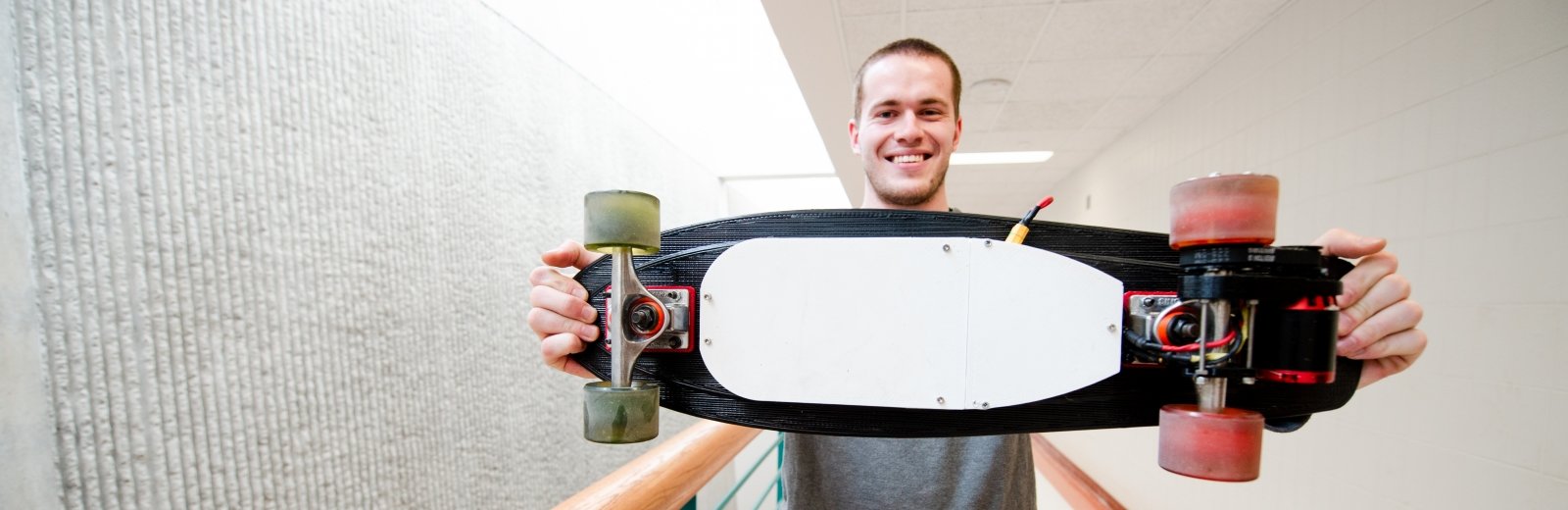

Bhisham Sharma joined Michigan Tech's Department of Mechanical and Aerospace Engineering as an associate professor in August 2023.
Sharma's research addresses the intersection of structural mechanics, dynamics, and acoustics. In 2016, he founded the MADLab (Mechanics, Acoustics, and Dynamics Lab) at Wichita State, and brought the lab and several student researchers to Michigan Tech in 2023. The MADLab aims to understand the fundamental mechanics of advanced structured material systems and leverage this understanding to create new technologies for aerospace and mechanical applications. It also seeks to have a transformative impact on global society through accessible and inclusive scientific research and education.
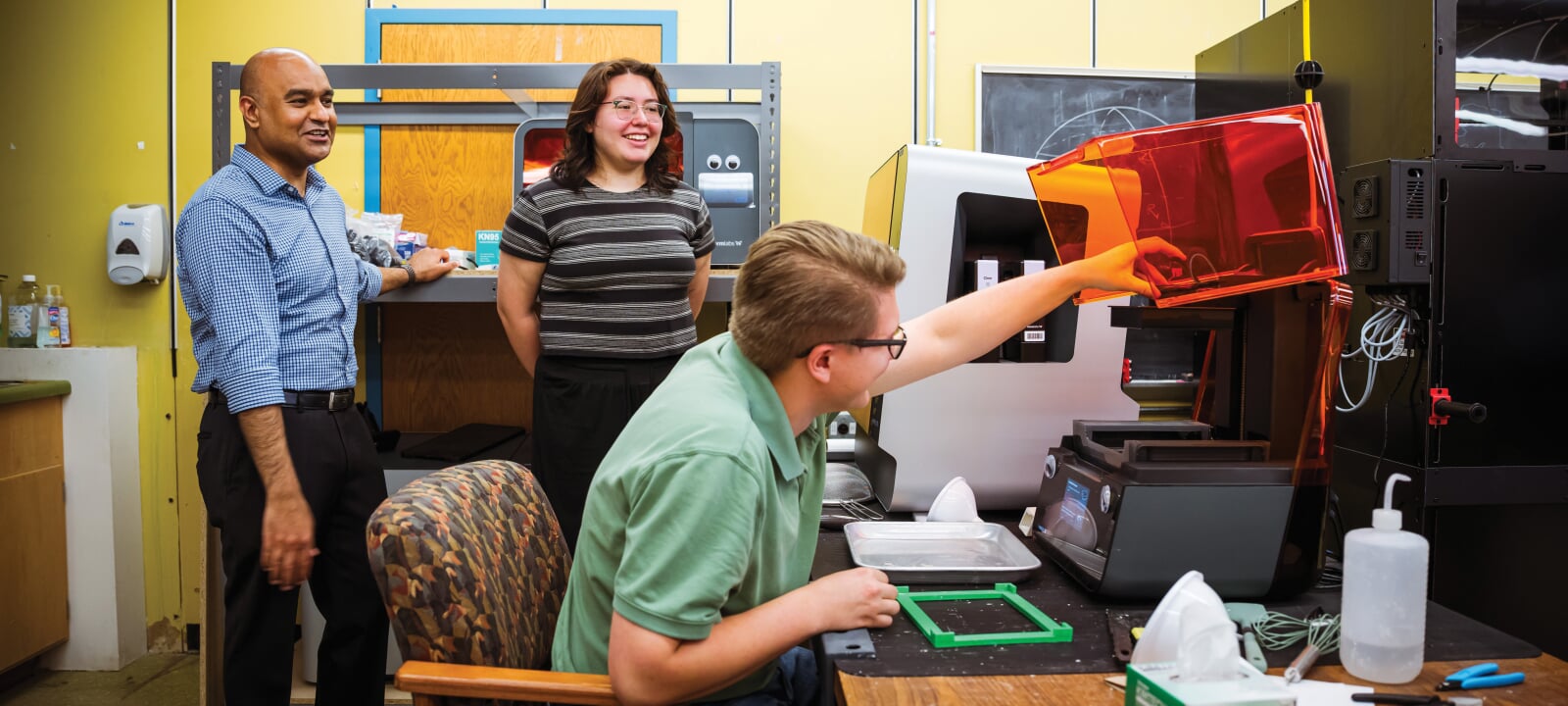
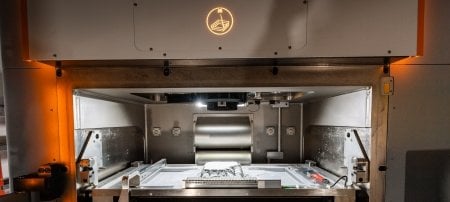
The MADLab at Michigan Tech includes two National Science Foundation Graduate Research Fellows; a NASA Jump Start Fellow; and undergraduate, graduate, and postdoctoral researchers—all working in a facility that may live up to its name. In the MADLab, 3D printers hum as troll figurines with long tresses smile down from shelves, drone wings sprouting synthetic hair whisper through revolutions, small balloonlike inflatables are tested for their surprising strength, and a jar of grape jelly sits on a shelf—proof of the cost-effective research happening in the MADLab. (We'll explain in a minute.)
Sharma's lab reflects his educational philosophy: The joy of university work comes from the intersection of helping students with top-tier talent grow their skills and the autonomy to pursue broad fields of research as new ideas and technologies come along.
Inspiration Is Everywhere
Aerogels are a class of synthetic materials produced by extracting the liquid component of a gel and replacing it with gas, resulting in an extremely lightweight material which can be up to 99.98 percent air by volume. Though aerogels have found applications in thermal blankets and as energy absorbers, their uses have been limited due to their fragility and lack of control over their macrostructure.
Feeding a hungry cat in the Sharma household was an unlikely inspiration for a new project: using additive manufacturing to create stronger, more consistent aerogels. The MADLab's aerogel research has led to new products and new manufacturing technologies. "That's the beauty of being at a university—you can experiment first with an end goal of finding a useful solution," said Sharma.
To Attract the Best Students, Be Unique
Sharma believes it's easier to attract, retain, and motivate students with unique projects, and the MADLab student team speaks to that philosophy.
PhD candidate Will Johnston first learned about 3D printing as a sophomore at Wichita State. Johnston began working with Sharma as an undergraduate researcher, experimenting with new methods of creating long, hairlike fibers using 3D printers. Johnston and Sharma looked to nature for potential applications for these fibers. They landed on owls, whose near silence in flight is due to the unique structure of their feathers.
Johnston is now the principal investigator on the AeroFeathers project, which uses 3D printing to fabricate biomimetic blades. These blades could be used to make drones, fans, HVAC systems, and industrial settings quieter. Their student team was awarded $80,000 from the NASA University Student Research Challenge (USRC). They'll use the award for fabrication, testing, and data analysis of AeroFeathers while embarking in a public crowdfunding campaign. AeroFeathers also won an honorable mention in the aerospace and defense category of the 2023 SAE Create the Future Design contest.
Don't Artificially Constrain Your Research Interests
The MADLab's research is broad-ranging. Lab members are doing additive manufacturing with synthetics, ceramics, and aerogels. They're creating TenseFlatables—stronger versions of lightweight inflatable devices often used in the aerospace industry. They're using a mathematical concept discovered around 190 BCE to design a new class of phononic structures. These are just a few of many examples. By embracing both the discovery mindset inherent at universities and the interests of his students, Sharma's MADLab is producing groundbreaking results in a wide variety of fields.
A major way the lab sidesteps budgetary constraints is by finding low-cost solutions whenever possible. "Low costs mean you can experiment a lot more," said Sharma. "If you break something, it's no big deal."
For example, finding a way to 3D print with ceramics could be a boon to the aerospace industry. But traditional 3D printers use solid plastic, and ceramics begin as a hot liquid and dry to a solid. So when the MADLab was challenged to convert a typical printer into a low-cost, direct-ink-writing printer that prints with liquids, they needed a cheaper way to prove the concept. Printing grape jelly onto a piece of bread was a cheap (and delicious) first-round solution.
Michigan Technological University is an R1 public research university founded in 1885 in Houghton, and is home to nearly 7,500 students from more than 60 countries around the world. Consistently ranked among the best universities in the country for return on investment, Michigan's flagship technological university offers more than 185 undergraduate and graduate degree programs in science and technology, engineering, computing, forestry, business, health professions, humanities, mathematics, social sciences, and the arts. The rural campus is situated just miles from Lake Superior in Michigan's Upper Peninsula, offering year-round opportunities for outdoor adventure.