Imagine tossing your morning iced coffee cup into a recycling bin, confident it will be remade into something new. Now, imagine a more likely outcome: That same cup, along with endless others, ends up in a landfill because it was too contaminated, too difficult to sort, or simply the wrong color for conventional recycling.
This frustrating reality, where an estimated 90 percent of plastics ultimately end up in landfills or incinerated, highlights a critical global challenge. But at Michigan Tech's Waste Valorization Lab, a team of dedicated mechanical engineers led by MAE's Professor Ezra Bar-Ziv and Assistant Professor Fei Long are redefining what's possible in waste management. The lab transforms benchtop-scale breakthroughs developed by Professor George Huber at the University of Wisconsin-Madison into pilot-scale machinery that promises significant financial and environmental returns.
Waste Valorization and Trash Confetti
Waste valorization, the process of converting waste materials into something with economic value, transforms trash into cash. It reduces landfill waste and creates new economic opportunities.
But there's a catch: Trash is far from uniform. "The trash content in Houghton might be different from Marquette," said Bar-Ziv. Variables like consumption habits, demographics, and even changing seasons lead to different waste composition.
The lab works with multiple waste streams. The first thing researchers address is the challenge of dealing with biogenic materials, like fibers, paper, and food scraps, found in municipal solid waste. Through a process of heating and stirring known as biomass torrefaction, organic materials can be converted into charcoal, offering a carbon-neutral energy source.
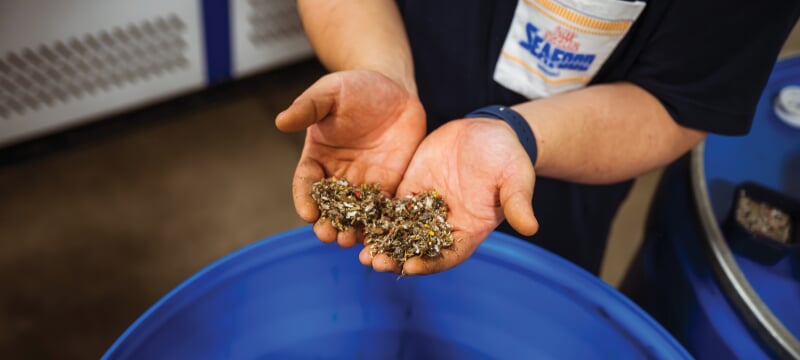
Getting unpredictable materials to flow smoothly through a system is an engineering challenge. Solids, unlike liquids, don't move easily. Bar-Ziv said they tend to clump and form "bridges," halting movement altogether. Years of testing led to an elegant solution: shredding waste particles down to confetti-like two- to three-millimeter pieces with an aspect ratio of approximately 1:1. Downsizing the debris reduces internal friction, allowing a continuous flow of material.
The result? A system that not only diverts biomass waste from landfills but also turns it into a valuable resource.
STRAP Technology Fuels the Breakthrough
Biomass valorization is impressive. But solvent-targeted recovery and precipitation (STRAP) is a game-changer that tackles one of recycling's most stubborn problems: mixed plastic waste.
Traditional recycling is a mechanical process where plastics are sorted by type, shredded, melted, and reformed into new products, albeit usually at a lower quality than their previous form. Like making a copy of a copy, repeated recycling reduces in quality every round due to contaminations and impurities, and the product eventually goes to a landfill.
Traditional recycling also struggles with sorting black plastics, contaminated packaging, and multilayered plastic films—all of which often end up in landfills.
"Polymer films often have 10 layers for oxygen barriers, adhesives, and rigidity," said Long. "Currently, there's no way to recycle them. STRAP changes that."
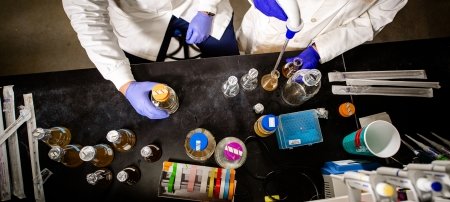
STRAP uses organic solvents specific to individual plastics, dissolving one type in a mixture without affecting the others. The dissolved plastic is then precipitated out and re-solidified, resulting in high-quality, colorless resin pellets.
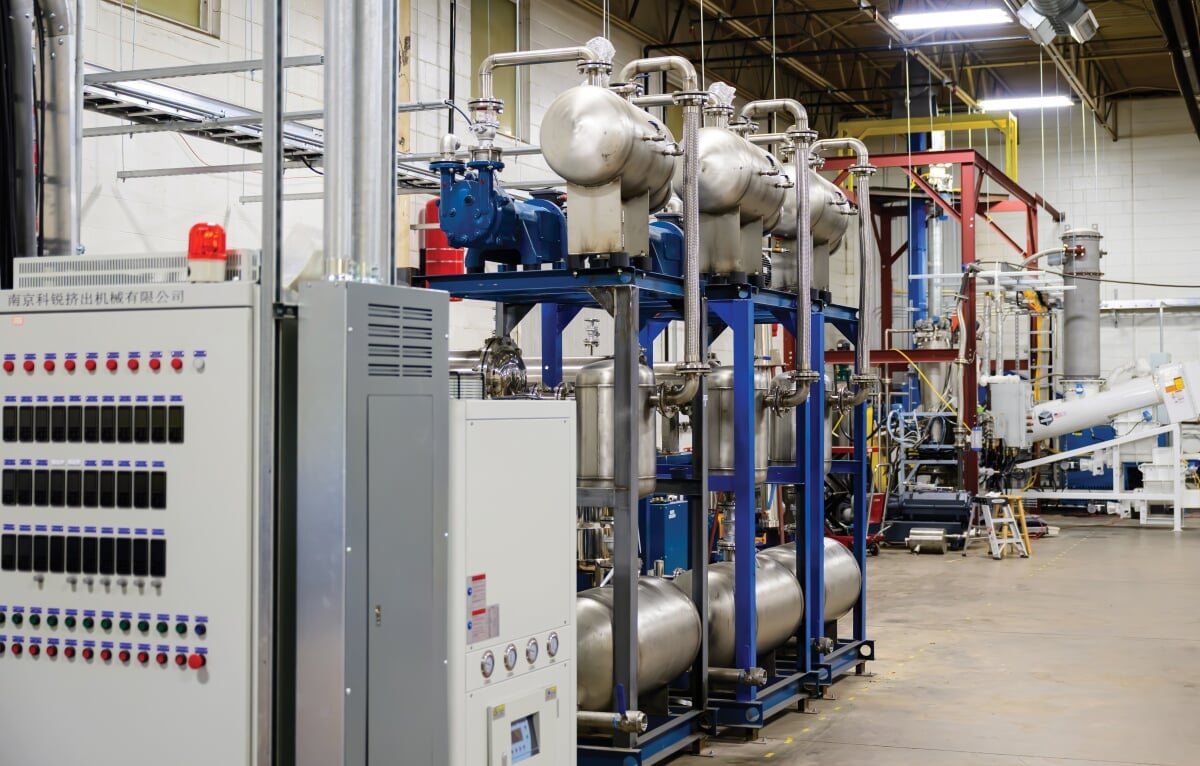
Scaling the technology hasn't been easy. At lab scale, researchers at UW-Madison process 10 to 100 grams using beakers and spoons. Moving to pilot scale, with a target goal of 25 to 50 kilograms per hour, was easier said than done.
Bar-Ziv compares it to moving from a tabletop pour-over coffee maker to opening a coffee shop. Much like a pour-over coffee, lab scale involves single-batch quantities processed as needed; the resins are often literally poured over a filter into a beaker. Pilot-scale processing requires moving materials continuously and smoothly through the system with no jams. To keep costs viable, 99.9 percent of solvents have to be recovered. And the entire process has to be automated, from valves to temperature controls.
Even the reactor required a rethink. At lab scale, dissolving plastics might take hours. Researchers developed a new high-speed, high-shear mixing design that enables the pilot lab to dissolve plastics in just 30 seconds.
"The reactor design alone took one PhD student's full dissertation," noted Long. The payoff? A process that can produce virgin-quality plastic from waste.
Smarter Sorting: AI and Infrared Characterization
To minimize costs and processing time, the lab needs to know what types of plastics need to be broken down. Traditional sorting can't detect the differences in black plastics, which make up a significant portion of waste. That's where the newest technology comes in: artificial intelligence-driven mid-infrared (MIR) spectroscopy.
Developed with collaborators in Denmark, the MIR prototype makes 20,000 measurements per second to characterize dark-colored plastics. Machine learning models then analyze the data in real time, identifying different polymers with near-perfect accuracy as they zip along a conveyor belt. This rapid characterization feeds into the STRAP system, helping researchers select the right solvents and temperatures for each batch.
The pilot project now offers a fully integrated approach: characterization, separation, and purification—with hopes to scale up to industrial levels.
A Brew Worth the Wait
The STRAP project exemplifies the progress that can happen through highly collaborative efforts involving multidisciplinary researchers from universities, national laboratories, and industry partners. It's supported by a range of funding sources, including the US Department of Energy and the National Science Foundation at the federal level; the Michigan Department of Environment, Great Lakes, and Energy at the state level; and private foundations, industry stakeholders, and engaged communities worldwide.
Together, the team is laying the foundation for a transformative approach to plastics recycling. If successfully scaled to commercial levels, the STRAP system has the potential to divert millions of tons of plastic waste from landfills annually.
"It really is like making coffee," said Bar-Ziv. "We extract the good stuff and leave the rest behind." And, with luck, STRAP-style labs will become nearly as prevalent as coffee chains in major metropolitan areas around the world.
Five years into the effort, the team remains optimistic about STRAP's potential, while recognizing it's a piece of a complicated puzzle. "We can't solve every problem with one technology," Bar-Ziv admitted. "Microplastics from tires or PFAS chemicals are different beasts. But for the plastics in your trash bin, STRAP could change the game."
For a world drowning in plastic, that's grounds for optimism.
Michigan Technological University is an R1 public research university founded in 1885 in Houghton, and is home to nearly 7,500 students from more than 60 countries around the world. Consistently ranked among the best universities in the country for return on investment, Michigan's flagship technological university offers more than 185 undergraduate and graduate degree programs in science and technology, engineering, computing, forestry, business, health professions, humanities, mathematics, social sciences, and the arts. The rural campus is situated just miles from Lake Superior in Michigan's Upper Peninsula, offering year-round opportunities for outdoor adventure.