Michigan Technological University researchers are involved in three proposals tapped by the U.S. Department of Energy for consideration under its recently launched Genesis Mission: Transforming Science and Energy with AI. The mission’s goal is to address national science and technology challenges using artificial intelligence.
The U.S. Department of Energy (DOE) selected one Michigan Tech-led research proposal and two others involving researchers in the University’s Department of Physics for award negotiations related to the Genesis Mission challenge “Predicting U.S. Water for Energy.”
“The Genesis Mission is the premier federal program advancing artificial intelligence in science,” said Andrew Barnard, Michigan Tech’s vice president for research. “Having Michigan Tech researchers lead and participate in Genesis projects reflects Michigan Tech as a premier R1 research institution with world-renowned faculty at the peak of their respective fields.”
The Genesis Mission brings together researchers, agency heads, Congressional members, scientific leaders and strategic industry partners to investigate solutions to 26 unique national science and technology challenges using artificial intelligence. The Genesis Mission is a historic national initiative led by the U.S. Department of Energy, which is building the world’s most powerful integrated science discovery platform. By uniting government, industry, academia and philanthropy, it is accelerating breakthroughs in energy, scientific discovery and national security through a new platform that combines AI, supercomputing, quantum systems and advanced scientific instruments.
The mission is currently in phase one, the goal of which is to identify promising pathways toward transformative scientific capabilities and establish a foundation for future investment and scale. Project teams will design and demonstrate research workflows that integrate AI with scientific investigation, while rigorously evaluating whether those approaches can accelerate discovery, improve predictive capabilities, enhance experimentation or generate new scientific insights.
Using Tech’s Pi Cloud Chamber to Predict Water Resources
Water availability is essential for expanding energy production, as well as for preserving and protecting the nation’s health and security. The Genesis Mission challenge “Predicting U.S. Water for Energy” seeks to address fundamental scientific gaps in scientists’ understanding of terrestrial and atmospheric systems that limit the nation’s ability to predict water resources, especially on the time scale of weeks to years. The vision is creating AI capable of multiscale temporal reasoning that could tackle three interrelated grand challenges: cloud physics, surface and subsurface water flows, and the broader hydrologic cycle.
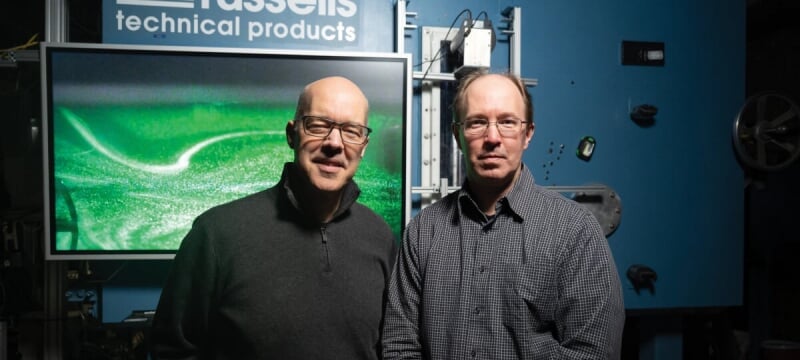
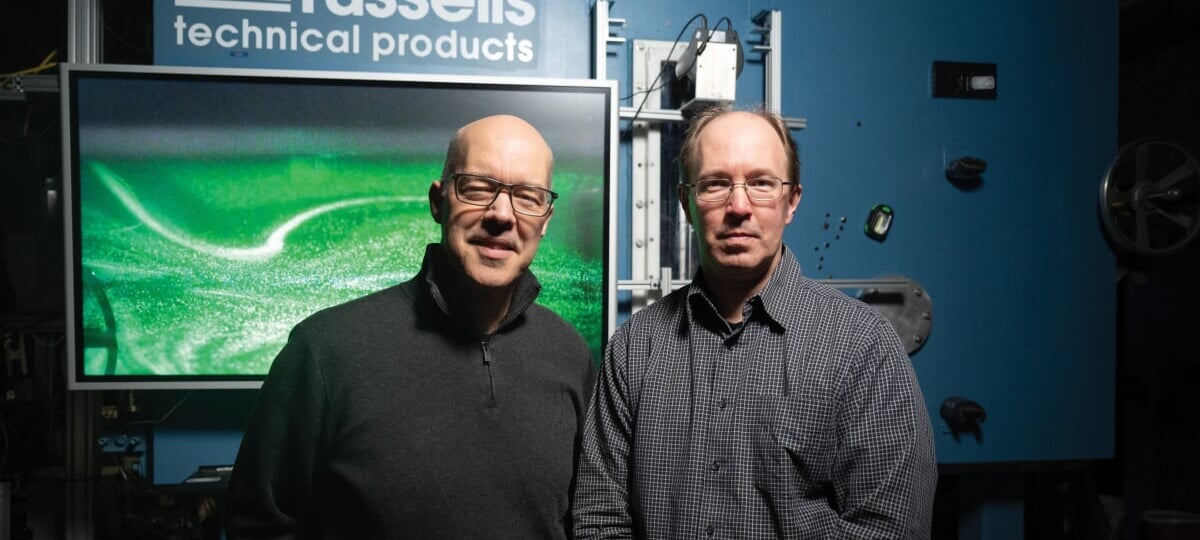
Michigan Tech’s Raymond Shaw, university professor of physics, is the principal investigator on the University’s proposal “AI-accelerated exploration of droplet collision-coalescence using observation constrained, multiscale modeling of a turbulent-convection cloud chamber.” The project proposes a two-stage, AI-enabled data-driven framework using the unique, dynamic steady-state of a convection cloud chamber.
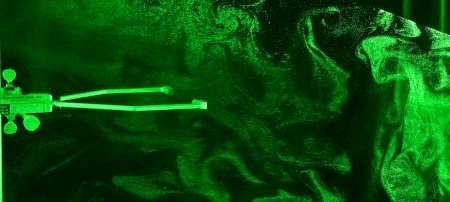
Shaw and his team of researchers intend to sample droplet size distribution fluctuations over time in Michigan Tech’s Pi Convection Cloud Chamber and extract fundamental microphysical parameters from the data. The information will be used to construct an efficient, reduced-order predictive model to anticipate when and how precipitation will develop, which affects water supply. The project aims to offer a comprehensive pathway for advancing next-generation cloud microphysics parameterizations. Project partners include Brigham Young University, Brookhaven National Laboratory (BNL), the National Center for Atmospheric Research (NCAR), Pacific Northwest National Laboratory (PNNL) and the University of Utah.
“One of our underlying philosophies is that machine learning and AI-accelerated scientific discovery will be most successful when guided by the combination of known physics and high-quality data,” said Shaw.
AI is only as good as its training data. In this team’s case, high-quality data comes from the Pi Cloud Chamber, providing high-fidelity training in circumstances not currently feasible from field measurements. This combination of measurements can also benchmark the computationally expensive numerical models, guiding them in the kinds of training that they can provide for the AI models.
“We have a good idea of what the physics of precipitation formation should look like, but there are large uncertainties in certain important bottlenecks in the formation process,” said Shaw. “By focusing on those bottlenecks, we can improve our understanding of physics, which in turn can impact the quality of computer models used for real-world decisions about water and energy infrastructure.”
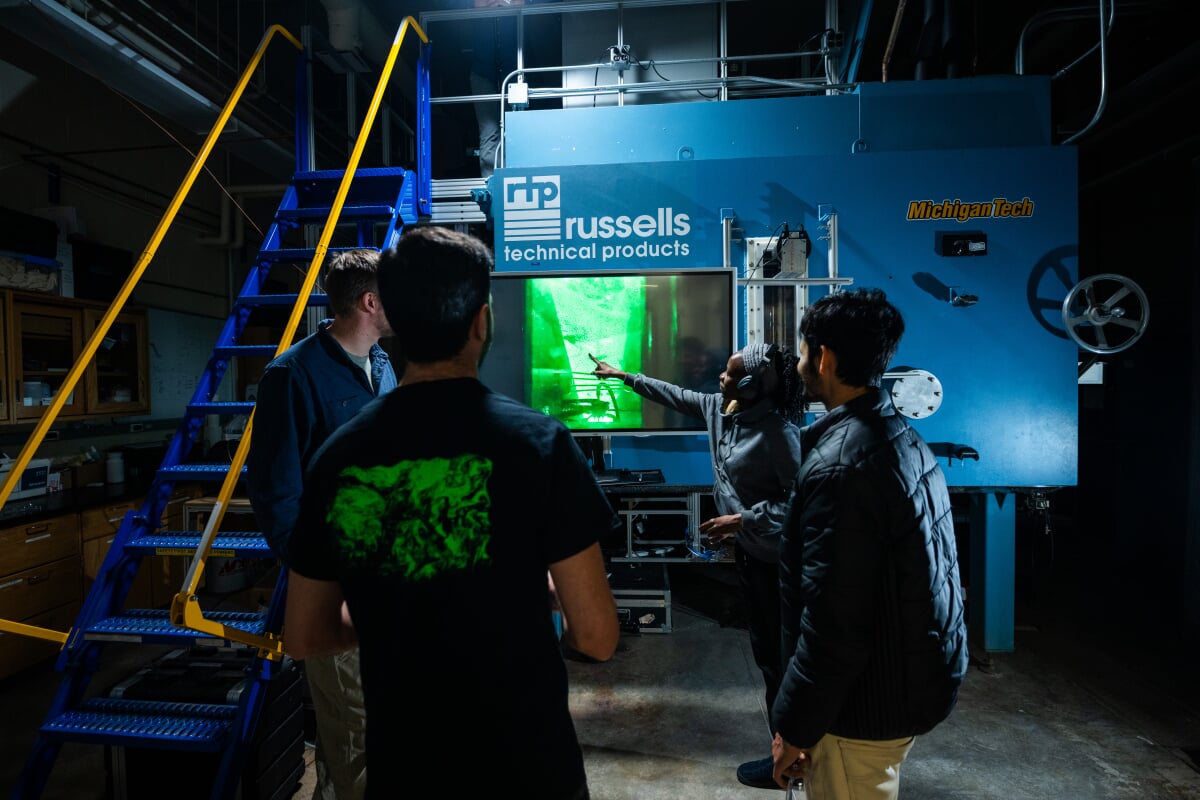
Shaw is also co-principal investigator on Brookhaven National Laboratory’s Genesis Mission proposal “An Automated, Multimodal-AI-Enabled Cloud Chamber for Constraining Cloud Microphysical Processes in Earth System Models.” BNL’s objective is to develop an embodied AI cloud chamber control system powered by a large language model to demonstrate the advantages of using AI in laboratory experiments, such as setting up a specific target, controlling experimental conditions and showing measurable performance gains.
Shaw has been collaborating with colleagues at BNL for several years as they’ve developed a cloud chamber to test technologies necessary as stepping stones toward the eventual construction of a large convection-cloud chamber for exploring clouds that form rain and snow. Tech’s Pi Cloud Chamber operation is already complex, and in a similar system on a larger scale, the complexity can become overwhelming.
“It’s a perfect opportunity for AI to play a role in allowing scientists to focus on the science, rather than details of wall-temperature configurations and other factors,” said Shaw. “In much the same way as a self-driving car allows the driver to provide a destination and not worry about each detailed turn or traffic structure in getting there, this envisioned system will allow scientists to formulate hypotheses and request desired cloud conditions, without having to find the necessary settings by trial and error.”
Will Cantrell, Michigan Tech’s associate provost, graduate school dean and physics professor, is co-principal investigator for Pacific Northwest National Laboratory’s Genesis Mission proposal “Earth-Atmosphere Agentic Research and Learning — Physics-Constrained AI Closure Development for Cloud Microphysics and Turbulence.” The project’s overall objective is to develop and demonstrate a physics-constrained, AI-enabled cloud microphysics closure for the Energy Research and Forecasting Model (ERF). The ERF model is a new solver for predicting mesoscale and microscale dynamics in the atmosphere, designed for emerging high-performance computing architectures. PNNL’s project hopes to capture the effects of unresolved fluctuations in water vapor concentrations on condensational growth and evaporation of cloud droplets, and to establish a human-supervised agentic workflow for rapid closure development, implementation and evaluation.
“We don’t know the whole chain of events that lead from cloud formation to precipitation,” said Cantrell. “However, we do know that when a small subset of cloud droplets reach a certain size threshold, that rain is more likely, but we can’t quite pin down yet how that happens. We will tackle that problem using careful laboratory experiments at Tech, coupled with PNNL’s insights on what AI can provide when fed that data.”
All three project proposals are currently in award negotiations with the DOE. Award announcements are expected in the coming months. Shaw attended the Genesis Mission Annual Summit on July 22, and is enthusiastic about his part in developing solutions to these long-standing science challenges. If the projects are successful, he believes they could radically improve the nation’s ability to anticipate water supply in the context of changing water availability, demands, energy technologies and ambitions for energy expansion.
“It’s an honor to be part of the inaugural teams in the Genesis Mission, and exciting to have this opportunity to further explore the physics of precipitation formation,” said Shaw. “Our collaboration draws from a wide range of scientific backgrounds. We’re looking forward to working together to develop AI-ready datasets and machine learning and AI tools that will help accelerate progress on a challenging science problem that is highly relevant to society.”
Michigan Technological University is an R1 public research university founded in 1885 in Houghton, and is home to nearly 7,500 students from more than 60 countries around the world. Consistently ranked among the best universities in the country for return on investment, Michigan's flagship technological university offers more than 185 undergraduate and graduate degree programs in science, technology, engineering, mathematics, computing, forestry, business, health professions, robotics, psychology, social sciences, humanities, and the arts. The rural campus is situated just miles from Lake Superior in Michigan's Upper Peninsula, offering year-round opportunities for outdoor adventure.