

Featured Research:
Bipedal Robots in Space
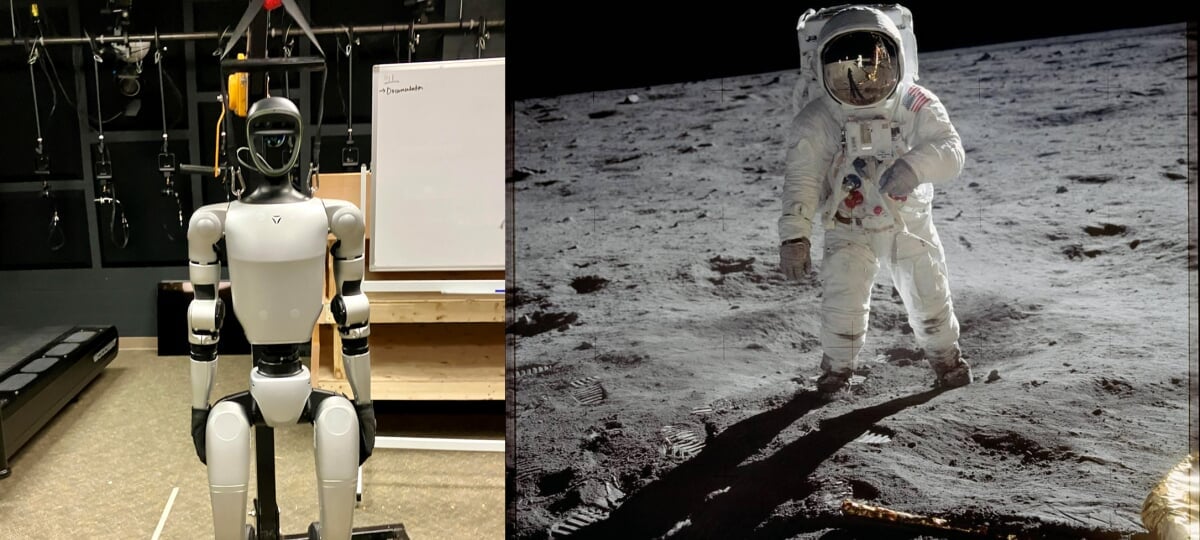
Beyond Earth, planetary exploration is still heavily reliant on wheeled rovers, which show limited mobility when it comes to difficult terrain and inclined regions, for instance, featuring rocks, craters, and narrow crevices. Bipedal robots hold promise for expanding the scope of tasks on the Moon due to their unique locomotion capabilities. However, the challenges of lunar gravity and the presence of fine surface’s dust pose stability challenges for these robots.
Led by Assistant Professor Tan Chen, this research seeks to gain a fundamental understanding of lunar bipedal locomotion mechanics and design robust and energy-efficient devices for bipedal robot locomotion on the Moon by using reinforcement learning. While working with a robot, this research has a translational impact on improving human locomotion strategies on the Moon. In addition to advancing novel knowledge and technology, this research will contribute to building and improving the robotics curriculum at Michigan Technological University while engaging undergraduate and graduate students, as well as high school students, in robotics education and research.
Lavender Robots
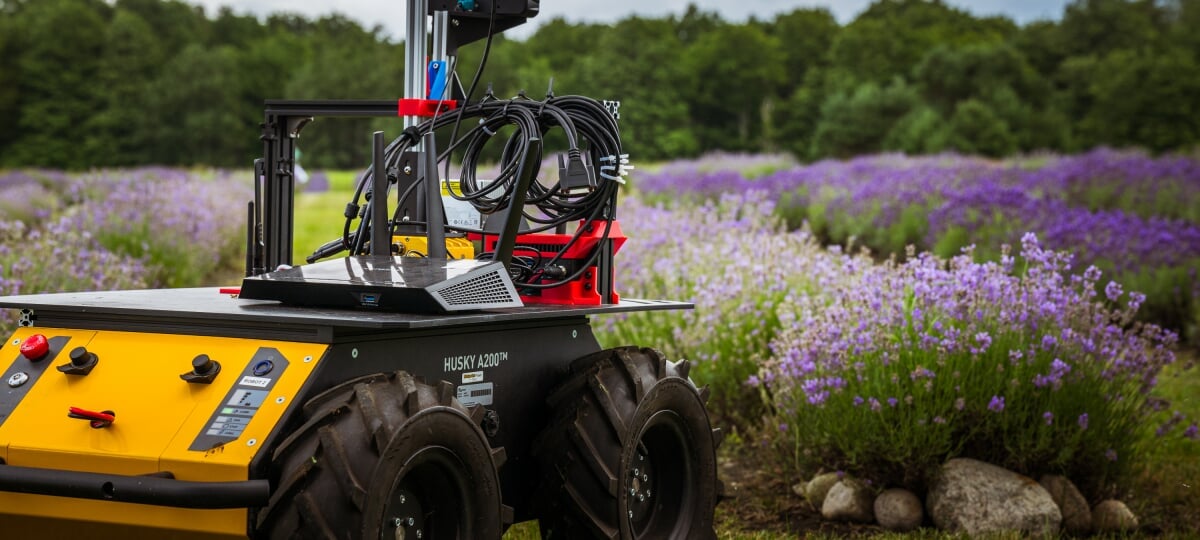
This project is transforming small-scale lavender farming by developing mobile harvesting robots equipped with advanced manipulators. Led by researchers at Michigan Technological University, the effort addresses labor shortages by creating automated systems that reduce costs and improve harvest quality.
Lucky Clover Farm in Gaylord, Michigan—home to seven lavender species with distinct stem and flower structures—serves as the primary testing site. To handle this diversity, the project is creating adaptive algorithms that allow robots to identify and harvest each species accurately and efficiently.
The resulting technology represents a major step forward for lavender farm automation and holds promise for broader use in small fruit and specialty crop production across Michigan.
Project Team: Jungyun Bae (PI), Vinh Nguyen, Myoungkuk Park
Meet Balto
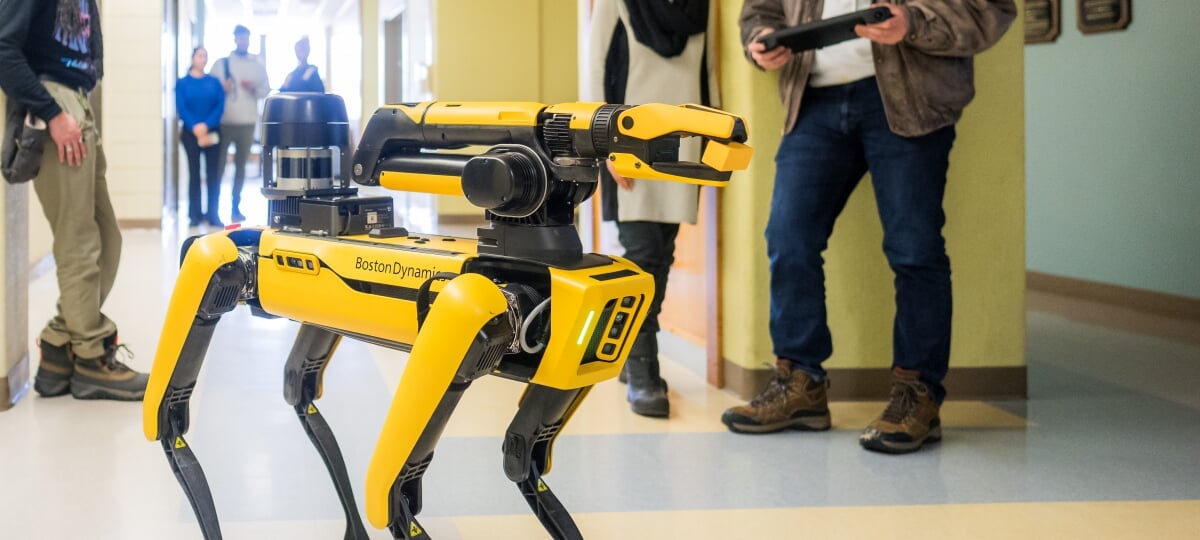
Michigan Tech’s quadruped robot “Balto,” a customized Boston Dynamics Spot platform, serves as a versatile research tool for advanced human–robot interaction studies. Designed for stable indoor and outdoor operation, Balto enables exploration of physical manipulation, mobile autonomy, and coordinated teamwork between robots and human operators.
Led by Assistant Professor Michael Walker, the research uses Balto to investigate how robots can support first-response scenarios, mixed-reality teleoperation, and collaboration alongside drones and humanoid systems. These capabilities position Balto as a key asset for developing next-generation robotic solutions that operate safely and effectively in complex, real-world environments.
Learn more about Balto here
Teleoperated Robotics
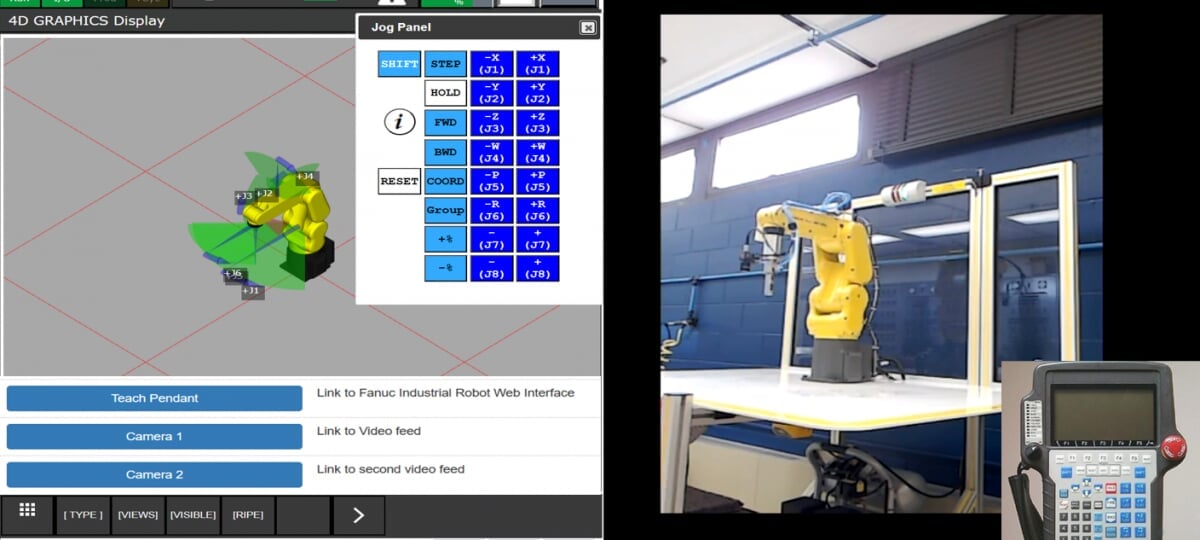
This research focuses on the development of digital twin–enabled teleoperation of industrial
robotic systems, enabling real-time remote interaction with physical robots through
synchronized virtual environments. The work centers on the design and implementation
of a Teleoperated Robotic Workcell that tightly couples a physical industrial robot
with its digital twin, allowing users to jog, program, and execute robotic operations
remotely with fidelity comparable to in-person laboratory access. The system integrates
industrial robot controllers, virtual iPendant interfaces, multi-angle live video
streaming, and a secure web-based scheduling and access platform to ensure accurate
synchronization between the digital and physical systems while maintaining industrial
safety and operational integrity.
By leveraging digital twin technology, this research expands access to advanced industrial
robotics infrastructure for students, industry partners, and workforce upskilling
populations who may not have direct physical access to robotic laboratories. The teleoperated
digital twin framework supports scalable experiential learning, repeatable training
scenarios, and controlled remote operation, while also establishing a foundation for
broader applications in remote commissioning, distributed manufacturing, and collaborative
industrial research. Future project expansion will integrate AI-based robotic vision
to enhance perception, autonomy, and intelligent human–robot interaction within the
teleoperated digital twin environment. This research program in digital twin-based
teleoperation of industrial robots is led by Dr. Aleksandr Sergeyev at Michigan Technological
University