
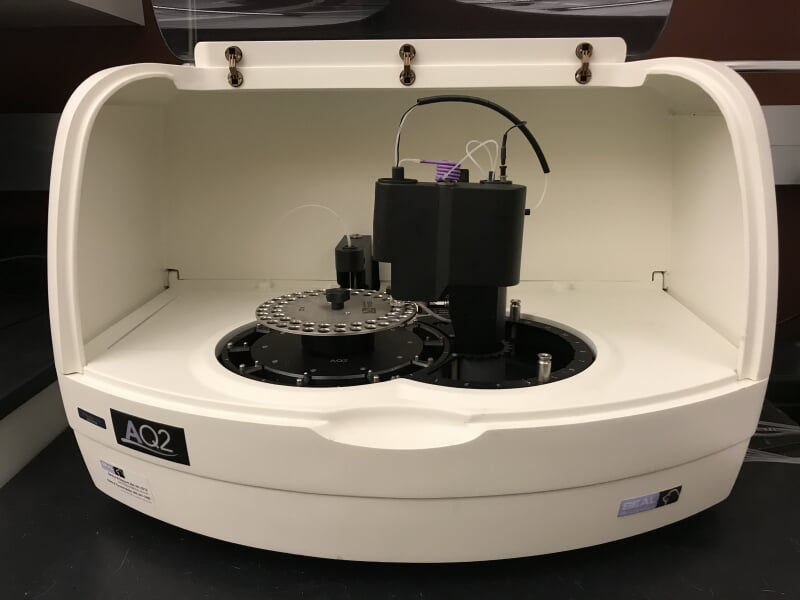
Location
Great Lakes Research Center 304A
Contact
906-487-2025
Access Type
Instrument Details
- Nitrate+nitrite: Nitrate + nitrite is analyzed using the SEAL Analytical AQ2 Discrete Analyzer. Nitrate is chemically reduced to nitrite with a cadmium coil. The nitrite (original nitrite plus nitrate from chemically-reduced nitrate) reacts with sulfanilamide and then couples with N-(1-naphthyl)-ethylenediamine dihydrochloride to form a magenta azo dye. The color is measured photometrically at 520 nm.
- Nitrite: Nitrite is analyzed using the SEAL Analytical AQ2 Discrete Analyzer. Nitrite reacts
with sulfanilamide and then couples with N-(1-naphthyl)-ethylenediamine dihydrochloride
(NEDD) to form a magenta azo dye. The color is measured photometrically at 520 nm.
Ammonium: Ammonium is analyzed using the SEAL Analytical AQ2 Discrete Analyzer. Ammonia reacts with hypochlorite, previously liberated from dichloroisocyanurate, to form a chloramine. At an alkaline pH of 12.6, salicylate and the chloramine react to form indophenol blue dye. The color is proportional to the concentration of ammonia, and is measured photometrically at 660 nm. - Total alkalinity (m-alkalinity): Total alkalinity is analyzed using the SEAL Analytical AQ2 Discrete Analyzer. The sample is added to a buffered (pH 3.1) potassium hydrogen phthalate (KHP) solution. The KHP solution neutralizes alkaline species in the sample and adjusts to a slightly higher pH. Methyl orange has a red to yellow color change; the pH range of its color transition from 3.0 to 4.5 encompasses the equivalence point of a titration for total alkalinity (4.5). The alkalinity of a sample leads to a red color loss proportional to the total alkalinity of the sample. The color is measured photometrically at 520 nm.
- Silica: Silica (SiO2) is analyzed using the SEAL AQ2 Discrete Analyzer. When combined with ammonium molybdate under acidic conditions, molybdate-reactive silica forms a yellow molybdo-silicic acid complex, which is then reduced with 4-amino-3-hyrdoxy-1-naphthalenesulfonic acid and forms a silico-molybdenum blue complex. The color is measured photometrically at 660 nm.
- Total phosphorus: Total phosphorus is measured by first converting organic and inorganic-bound phosphorus compounds to soluble phosphorus through digestion. The AQUA Lab uses an alkaline persulfate digestion, which becomes acidic during autoclaving to facilitate the conversion of bound phosphorus compounds to soluble phosphorus. After digestion, an antimony-phospho-molybdate complex is formed when acidic molybdate and antimony potassium tartrate react in the presence of orthophosphate. Ascorbic acid reduction of this complex yields phosphomolybdenum blue; the phosphorus concentration is proportional to the color, measured with a spectrophotometer at 880 nm.
Capabilities
- Nitrate+nitrite
- Nitrite
- Ammonium
- Total alkalinity (m-alkalinity)
- Silica
- Total phosphorus (not on AQ2 - direct charge)
Vendor
SEAL Analytical