

APS LABS delivers comprehensive vehicle system testing spanning component, subsystem, and full system verification. Our team integrates advanced instrumentation and high-fidelity data acquisition to generate results that accelerate development and reduce risk.
Through access to the American Center for Mobility smart proving grounds, originally established in 1941 as a historic World War II bomber plant, APS LABS supports advanced mobility evaluation across 500 acres of diverse infrastructure, highway loops, urban intersections, and intentionally challenging road surfaces representative of real-world driving conditions. Specialized vehicle labs and connected environments enable repeatable connected and automated vehicle (CAV) validation.
Through access to the Keweenaw Research Center mobility proving ground, originally established in 1953 as a U.S. Army field station, we support all-season evaluation across 900 acres of diverse terrain, slopes, mobility obstacles, and groomed winter surfaces representative of Arctic conditions. Cold rooms and controlled environments enable repeatable low-temperature validation.
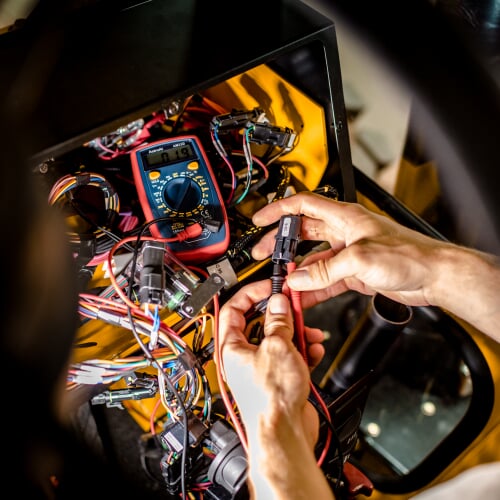
Figure 1. Verification of components on a prototype material handler.
Testing capabilities include multiple dynamometer test cells capable of evaluating engines, drivetrains, and electric machines. The laboratory has bidirectional grid interoperability of 2 megawatts, with six test cells with individual engine, transmission, and hub dynamometers enabling testing of engine and electric powertrain systems. APS LABS supports powertrain calibration, electrified drivetrain development, and performance characterization under representative operating conditions.
Suspension Parameter Identification Device and Evaluation Rig (SPIDER)
APS LABS has a heavy-duty Suspension Parameter Identification Device and Evaluation Rig (SPIDER) rig, also known as a Kinematics and Compliance (K&C) test rig. This equipment allows for testing of heavy-duty vehicle chassis and suspensions systems and is designed to evaluate ride and handling performance for wheeled vehicles with up to 25,000 pounds per wheel. The rig can measure key suspension and steering parameters, including spring and shock force–deflection behavior, damping characteristics, roll center and roll steer, suspension roll moment and damping, tire force response, and overall chassis compliance. These data enable high-fidelity modeling of suspension dynamics and rapid assessment of engineering changes to components or configurations. The SPIDER’s ability to characterize suspension behavior under controlled conditions provides essential input for dynamic simulations, durability analysis, and mobility modeling, offering a level of diagnostic precision rarely available outside major OEM facilities.