

APS LABS applies life-cycle assessment methods to evaluate the environmental impacts of electricity generation, distribution, and end-use electrification. Our analyses quantify how grid mix, transmission losses, energy storage, and charging infrastructure influence total greenhouse gas emissions and system-level sustainability outcomes.
In the Mackinac Island Ferry electrification study, APS LABS conducted a detailed well-to-wheel analysis comparing diesel and battery-electric configurations under different grid scenarios. The results demonstrated that total lifecycle emissions are highly sensitive to upstream electricity generation pathways, battery manufacturing impacts, and operational duty cycle. This work highlights how grid composition directly affects the environmental benefit of electrification.
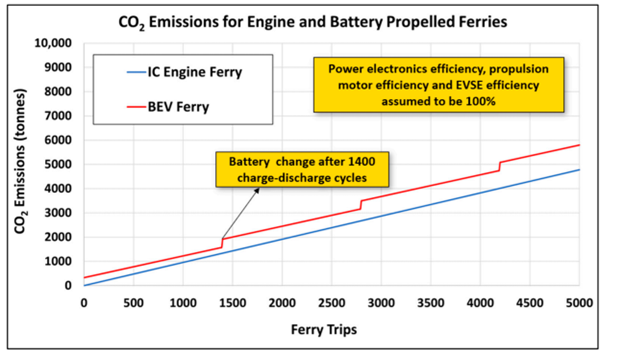
Figure 1.CO2 emissions for BEV and IC engine configurations of the Mackinac Island ferry assuming power electronics efficiency, propulsion motor efficiency, and EVSE efficiency to be 100%.
Additional work on a heavy-duty off-road material handler integrated lifecycle emissions modeling with electrification architecture selection and cost-of-carbon-abatement analysis. This framework enables comparison of propulsion systems not only on performance and cost, but also on marginal emissions reduction per dollar invested, accounting for electricity generation mix and operational energy demand.
Together, these efforts demonstrate APS LABS’ capability to evaluate grid-integrated technologies using rigorous, decision-oriented LCA methods. Our work supports stakeholders in understanding how power generation pathways, distributed energy resources, and electrified loads interact to determine real-world carbon outcomes, enabling informed investment in resilient, lower-emission energy systems.
Read more about a few of our recent LCA studies: