| "The
environment, the faculty and staff, the field projects, the lab work,
the technology available; all these things allow you to acquire the knowledge,
skills, and experience you need to hit the ground running after graduation."
—Grant
L. Day, RPA
Principal
Investigator
Kentucky
• Located in historic mining region • Assistantships,
internships available
• National historical park nearby
About
Industrial Archaeology
Industrial archaeology (IA) is the recording, study,
interpretation, and preservation of the physical remains of industry-related
artifacts, sites, and systems within their cultural and historical contexts.
These remains may be as old as a seventeenth-century bloomery forge, or
as recent as an abandoned mid-twentieth-century steel mill. In practice,
IA in the US and UK generally focuses on the period of the industrial
revolution and later, though there is a strong connection to the study
of earlier technologies, particularly in the area of archaeometallurgy.
Industrial archaeology emerged as a distinct field of study in the United
Kingdom in the 1940s and 1950s, when historians, preservationists, archaeologists,
and engineers became concerned that many of the key relics of Britain’s
industrial heritage were disappearing. By the 1960s and 1970s, the IA
movement had spread across the Atlantic to the United States, as well
as to continental Europe, spawning several journals and a number of professional
associations, including the Society for Industrial Archaeology, which
is based here at Michigan Tech.
Master
of Science Degree in Industrial Archaeology
The MS in Industrial Archaeology at Michigan Tech is unique in the United
States and one of the few in the world to explicitly study industrial
archaeology. The IA program emphasizes a truly interdisciplinary approach
to to the field, fusing the academic perspectives of archaeology, historic
preservation, history of technology, architecture, and anthropology. Students
complete course work in all of these areas, in addition to approved electives
of the Department of Social Sciences or other departments at Michigan
Tech.
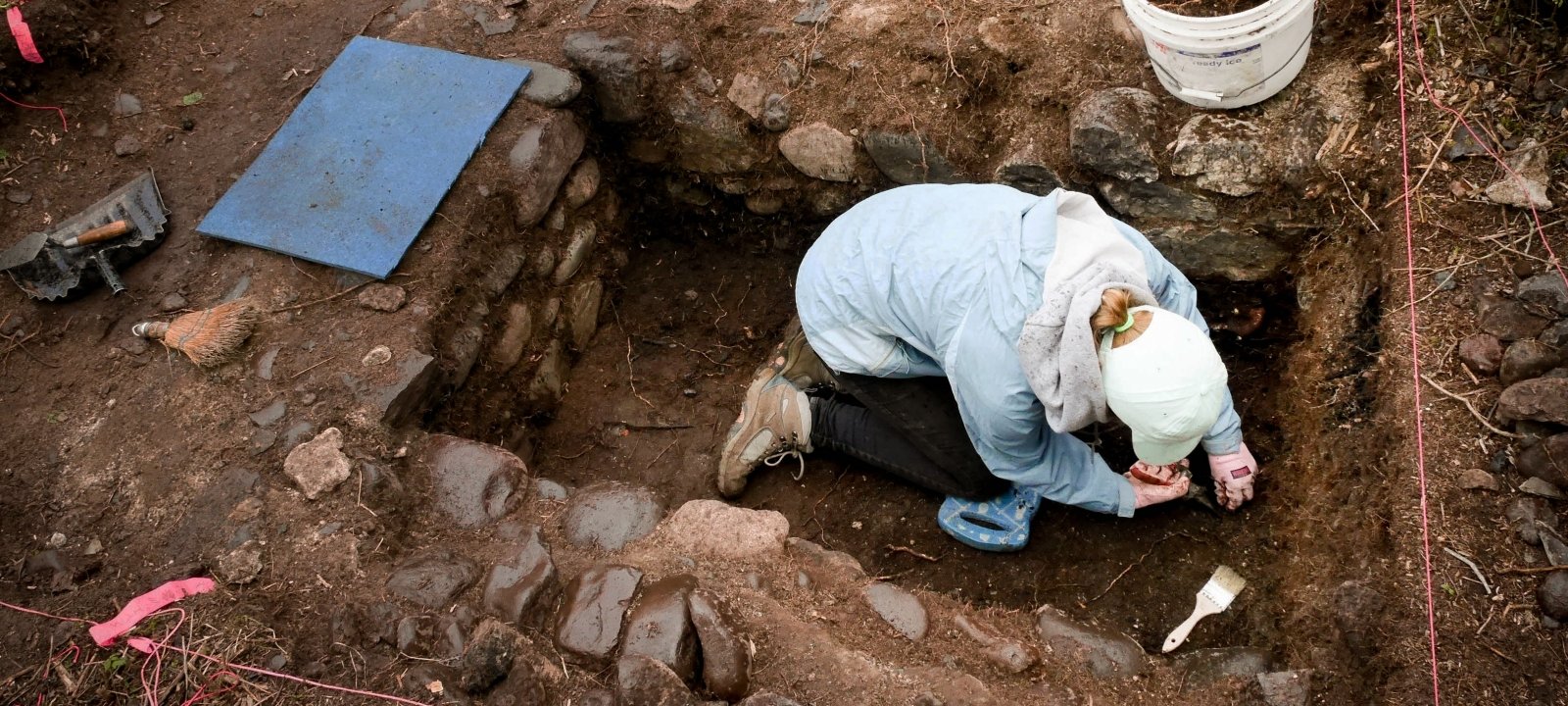
Fieldwork is an essential part of the program; it includes both traditional
and archaeological survey and excavation, as well as architectural and
archival research. Hands-on experience is central to our program.
Nearly 100 percent of the students who enter the program complete it,
and most students do so in two academic years, using the summers to fulfill
the program’s archaeological fieldwork and thesis requirements.
Current and Recent Projects
- Archaeological
study of a nineteenth century foundry complex on the Hudson River near
New York city
- Excavation
and interpretation of the first iron smelting site in Michigan
- Cultural
landscape studies of copper and gold mining sites in Alaska
- HAER
documentation of gold mining sites in Death Valley, Nevada
- Excavation
of mining company blacksmith shop in northern Michigan
- Architectural
study of mining company housing and neighborhoods in Upper Michigan
Resources
The IA program maintains close ties with the Michigan Historical Center,
the US Forest Service, and the National Park Service. MTU is close to
many industrial sites within Keweenaw National Historical Park, Isle Royale
National Park, and the Hiawatha and Ottawa National Forests.
The Archaeology
Laboratory has worked closely with both the state of Michigan and the
federal government on a number of projects, such as the Ohio Trap Rock
copper mine site from the 1850s and the Carp River Forge Project in Negaunee,
Michigan, the region's first iron-making site. The laboratory serves as
the curation facility for archaeological materials from both Hiawatha
and Ottawa National Forests, as well as for material from the state of
Michigan.
The J. R.
Van Pelt Library, in addition to its extensive holdings on industrial
technology and history, maintains the Copper Country Archives, containing
a massive amount of original documentary material. Holdings range from
historic photos of the Keweenaw Peninsula to the records of many of the
copper mining companies that dotted the region.
The department
strives to support all IA graduate students through its ongoing projects
and through MTU-funded teaching assistantships. Research internships are
sometimes available to interested students though connections with the
US Forest Service, the Michigan Historical Center, and others institutions.
For
more information, contact
Patrick Martin, Director of Graduate Studies in IA
Department of Social Sciences
Michigan Technological University
1400 Townsend Drive
Houghton, MI 49931-1295
906-487-2113
pem-194@mtu.edu
http://www.industrialarchaeology.net |