Diverse Ecosystem of Environmental Stewardship
If you have a love for the woods and a desire to sustain resources for the future,
you will feel at home in Michigan Tech's College of Forest Resources and Environmental
Science (CFRES). Our College is a community on a first-name basis, connected by a
shared passion for study, research, and work centered on forest health and ecosystem
integrity.
Similar to the Keweenaw Peninsula's biodiverse ecosystems, CFRES is a community of
undergraduates, graduates, faculty, staff, and alumni who learn, lead, and thrive
in the College's unique environment. You'll notice flags from countries around the
world when you step through the doors of our atrium. We are a safe space for all who
love natural resources, with a strong commitment to a sense of community.
5,850+ Acres of University Forestland
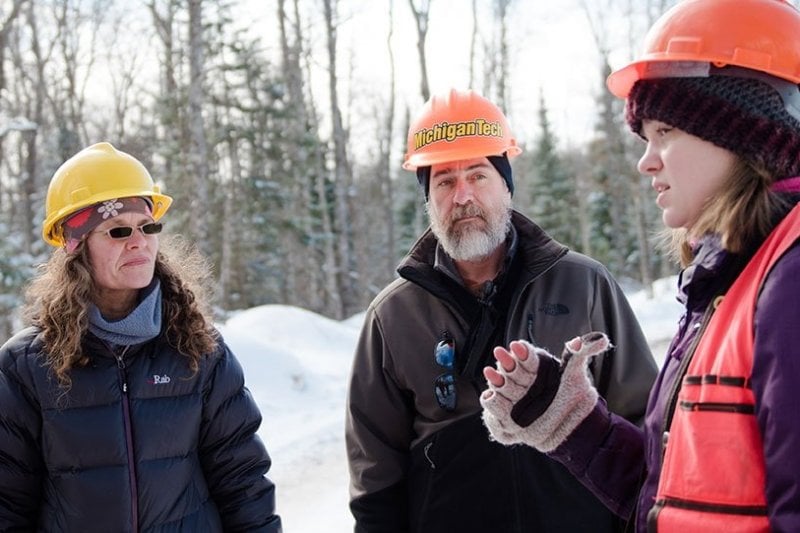
Our forests are your living lab—and playground. The University owns 5,866 acres of
forestland. Undergraduate students in forestry, wildlife, ecology, and soils perform
a minimum of 714 hours of outdoor coursework to fulfill degree requirements.
Learn how to navigate among the trees, count board feet, identify forest pests and
diseases, and explore ways to mitigate them. Take a swim in the Sturgeon River while
taking water samples, quantify woody and herbaceous plants, design maps, and learn
to mark timber. Work closely with your peers and professors to create management plans
that best suit the environment for the changing climate. Tap maple trees, learn the
history of syrup-making, and process your own maple syrup at the Nara Family Maple Center.
Integrated Field Practicum at the Ford Center
The Integrated Field Practicum (IFP) is the cornerstone of natural resource management
at Michigan Tech, and stands out as the only off-campus, semester-long field practicum
in the United States. Offered in the fall and summer, students in their junior year
get to live, learn, and play in our 3,700-acre research forest for a whole semester.
Spend a few hours in the classroom and the rest of the day outdoors at Michigan Tech's
Ford Center, just over 40 miles from our main campus.
Take waypoints and design maps. Get your hands dirty and your feet wet exploring soil,
geology, and climate. Collect fungi or insects for a specimen collection. Hug trees
as you measure stand basal area. Learn to determine canopy health. Collect photos
from camera traps. Mental and physical challenges prepare students for careers in
our four land management degree programs.
4+1 Accelerated Master of Forestry
Earn an accelerated master's degree with just one additional year of study beyond
your bachelor's degree in forestry. Start your Master of Forestry degree your senior
year, saving time and money on the graduate degree. This professional degree expands
your qualifications and experience in mapping, analyzing, managing, and communicating
forest and environmental resources issues. A master's degree provides greater opportunity
for career advancement and a higher starting salary.
Tomorrow Needs Sustainable Forest Management
Healthy, intact, functioning ecosystems support both human health and the health and
well-being of other species, from trees to birds, fish and insects. Join a community
that believes in renewable resources, sustainability, and multiple-use forests in
a sustainably driven society at an R1 flagship public research university powered
by science, technology, sustainability, and passion. Graduate with a foundation of
knowledge and real-world experience in natural resource management.