

Michigan Tech Researchers Develop Self-Fueling Marine Battery for DARPA BLUE Program
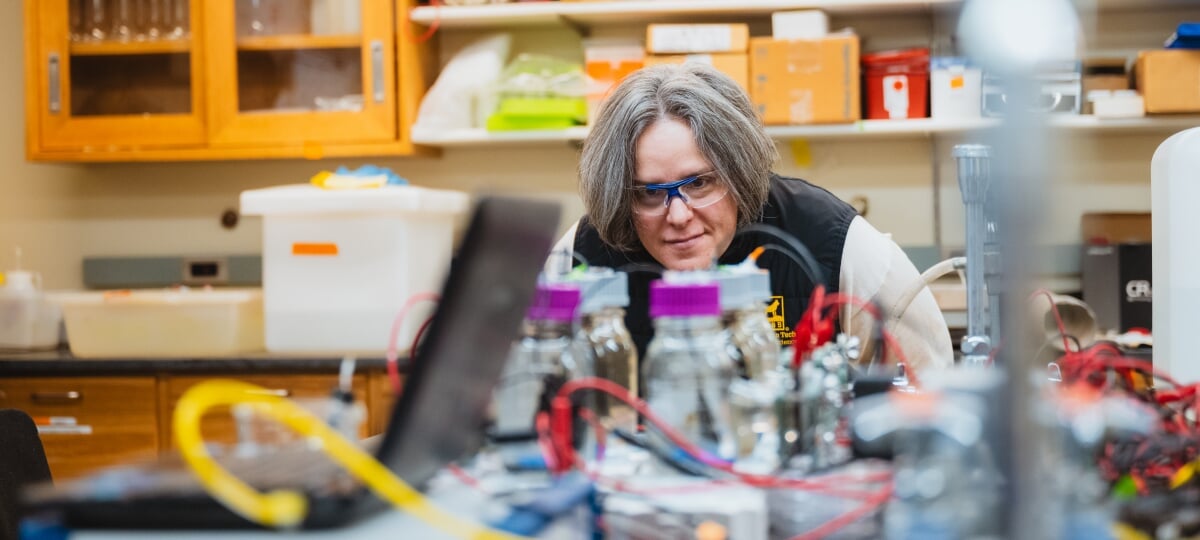
Led by Distinguished Professor Amy Marcarelli (BioSci), Michigan Tech researchers and collaborators are developing a self-refueling power supply for underwater sensors. The team’s microbial fuel cell converts dissolved organic matter and microscopic forms of marine biomass into electrical power.
Marcarelli is the principal investigator of the project, which is funded under the Defense Advanced Research Projects Agency (DARPA) BioLogical Undersea Energy (BLUE) program.
“The basic idea is that microbes move electrons around during their metabolic processes. In a microbial fuel cell, those processes transfer electrons from an anode to a cathode, creating an electrical current we can harness,” said Marcarelli.
The project is made possible through synergy between a strong lineup of co-principal investigators, including Jennifer Becker (CEGE/BioSci), Michael Sayers (MTRI), Jamey Anderson (GLRC) and Gordon Parker (MAE). Additional co-PIs are Steve Techtmann of Ohio State University, Mario Tamburri of the University of Maryland and Juliana D’Andrilli of the University of North Texas.
Dive into the project, which combines biology, engineering, research and data science, on Michigan Tech’s Unscripted Research Blog.