-
Origins of Orbion: When Preparation Meets Opportunity
Houghton is the launch pad for Orbion Space Technology, one of the brightest stars in a newly imagined space economy where small satellites are huge game changers. Research ingenuity and the right timing coalesced to propel Orbion forward following its . . .
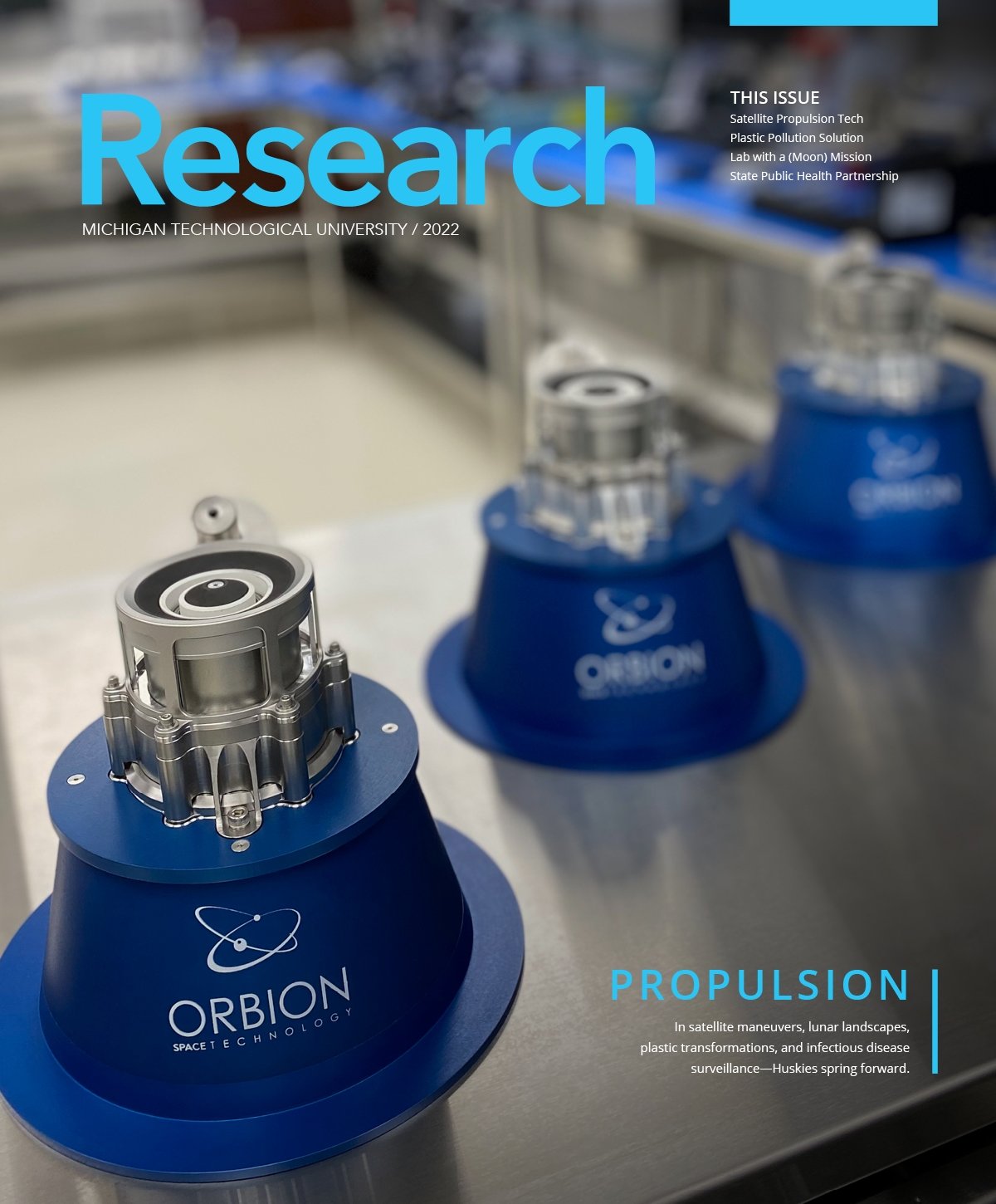
On the cover: In satellite maneuvers, lunar landscapes, plastic transformations, and infectious disease surveillance—Huskies spring forward. Image Credit: Jason Makela
Research is published by University Marketing and Communications and the Vice President for Research Office at Michigan Technological University, 1400 Townsend Drive, Houghton, Michigan 49931-1295.
- Nicole Kelly—Creative Director
- John Lehman—Vice President for University Relations and Enrollment
- Ian Repp—Associate Vice President for University Marketing and Communications
- David Reed—Vice President for Research
- Cathy Jenich—Assistant to Vice President for Research
- Natasha Chopp—Research Office
- Cyndi Perkins—Senior Content Specialist
- Jessie Tobias—Copy Editor
- Sarah Atkinson—Studio Production and Creative Manager
- Ben Jaszczak—Multimedia Specialist
- Megan Ross—Digital Support Manager
- Jen A. Miller—Freelance Writer
- Joel Van Diepenbos—Student Photographer
- Comments to the editor
magazine@mtu.edu - Address changes
gccolaro@mtu.edu
Learn more about research at Michigan Tech online.